
Most people assume that generic drugs are always cheaper than brand names. That’s true - but not always. Some generics are surprisingly expensive, even when there’s a simpler, lower-cost way to get the same medicine. The real savings often come not from switching from brand to generic, but from switching one generic to a different generic - or better yet, to a combination product.
Why Some Generics Cost More Than Others
Not all generics are created equal. Two pills with the exact same active ingredient can cost wildly different amounts. In 2022, researchers analyzed over 1,000 of the most commonly prescribed generics in Colorado. They found 45 that were costing far more than they should. These weren’t brand-name drugs. They were generics - but priced like they were still under patent protection. The average cost of these high-priced generics? $7.5 million in total spending across the state. The lowest-cost alternative? Just $873,711. That’s an 88.3% drop in cost - and zero loss in effectiveness. The reason? Often, it’s just a different strength or form. One pill might be 10 mg, another 5 mg. One might be a tablet, another a capsule. But if your doctor prescribes two 5 mg pills instead of one 10 mg pill, you’re paying less - even if both are generics. This isn’t rare. In fact, 62% of the high-cost generics identified in the study could be replaced with a cheaper version of the same drug, just in a different form or dose. That’s not switching brands. That’s switching to a better-priced version of the same medicine.Combination Drugs: One Pill, Two Drugs, Big Savings
Combination drugs - pills that contain two active ingredients in one tablet - are where the biggest savings often hide. Take asthma inhalers. Before generics arrived, Advair Diskus cost around $334 per inhaler. That’s a lot for a month’s supply. Then came Wixela Inhub, the generic version. It cost $115. That’s a 65.6% drop in price. But here’s the catch: Advair Diskus is already a combination drug. It contains fluticasone and salmeterol. The generic Wixela Inhub is the same combination - just cheaper. So the savings aren’t just from going generic. They’re from replacing a high-cost branded combination with a low-cost generic combination. The same pattern shows up in other areas. For high blood pressure, a combination pill like Amturnide (aliskiren, amlodipine, hydrochlorothiazide) was priced at over $200 per month before generics. Now, buying the three separate generics - aliskiren, amlodipine, and hydrochlorothiazide - costs less than $15 total per month. That’s a 90% savings. But here’s the twist: if you take those three pills separately, you’re taking three pills a day. The combination pill? One pill. So you trade convenience for cost. For many patients, especially older adults or those managing multiple conditions, taking one pill instead of three matters. So the real question isn’t just “which is cheaper?” It’s “which gives me the same result with the least hassle and lowest out-of-pocket cost?”How Competition Drives Down Generic Prices
Generic drug prices don’t drop because companies feel generous. They drop because more companies enter the market. The FDA says that when three or more companies make the same generic, prices start to fall fast. With five or more, you see drops of 80% or more. Take Crestor (rosuvastatin). When it went generic in 2015, the brand cost $5.78 per pill. Today, the generic? $0.08. That’s 99% cheaper. Why? Because over 50 companies now make rosuvastatin. The same happened with Prilosec (omeprazole). In 2001, it cost $3.31 per pill. Now, it’s $0.05. Again - 98% cheaper. This isn’t magic. It’s basic economics. More suppliers = more competition = lower prices. But here’s the problem: some markets don’t have that competition. If only one or two companies make a generic, prices stay high. That’s why some generics - even for common drugs - still cost $50 or $100 a month. They’re not monopolies. But they’re close.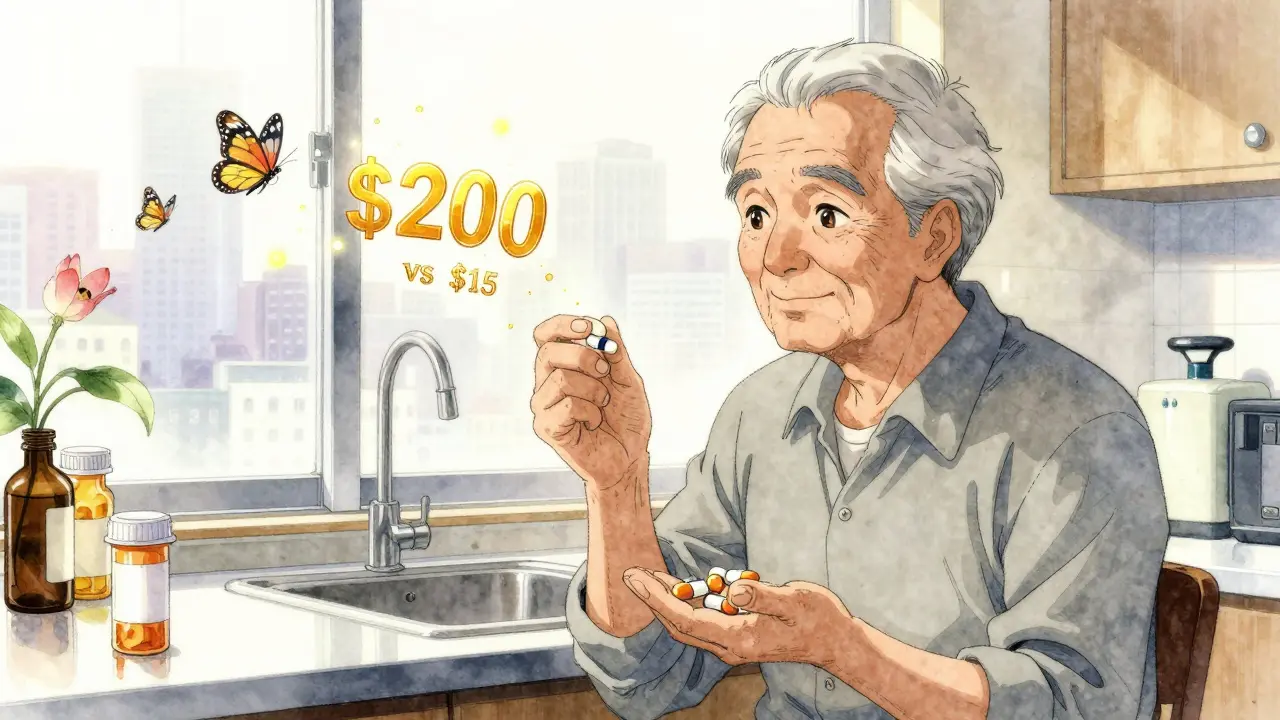
Who Benefits the Most From Generic Substitution?
The biggest savings go to people without insurance. A 2023 study looked at over 840 million prescription fills across the U.S. It found that uninsured patients saved an average of $6.08 per prescription when they switched to a cheaper generic or combination. That’s huge when you’re paying out of pocket. People on Medicare saved $4.64 per script. Private insurance patients saved $3.69. But Medicaid patients? Almost no savings. Why? Because Medicaid already negotiates low prices upfront. There’s not much room to drop further. The real win? When you switch from a high-cost generic to a low-cost generic - or from a branded combination to a generic combination - you’re not risking your health. You’re just saving money. The FDA’s Orange Book lists which generics are therapeutically equivalent. If a drug has an “A” rating, it’s safe to swap.What You Can Do to Save
You don’t need a PhD to save hundreds a year on meds. Here’s how:- Ask your pharmacist: “Is there a cheaper generic version of this?” Even if it’s already generic, there might be a different brand or formulation that costs less.
- Ask your doctor: “Can I take two separate generics instead of one combination pill?” Sometimes it’s cheaper - even if you take more pills.
- Check the price difference between buying the combination vs. buying each drug separately. Use tools like GoodRx or your pharmacy’s price checker.
- Ask your insurance plan: “Are there any high-cost generics on our formulary that could be replaced?” If you’re on a group plan, your employer might not know some generics are overpriced.
- Don’t assume your prescription is the cheapest option. A 2022 study found that nearly 90% of the savings came from swapping one generic for another - not from switching from brand to generic.

Why This Matters Beyond Your Wallet
Saving money on prescriptions isn’t just about being frugal. It’s about sticking to your treatment plan. If a pill costs $300 and you can’t afford it, you skip doses. You run out early. You stop taking it. That leads to worse health - and higher costs down the line from ER visits or hospital stays. When you switch to a $30 generic instead of a $300 one, you’re more likely to take it every day. That’s better health. And it’s cheaper for the whole system. The U.S. spent $3.7 trillion on prescription drugs over the last decade. Generics saved $3.7 trillion of that. But the biggest savings aren’t from switching brand to generic. They’re from switching expensive generic to cheap generic. Or from branded combo to generic combo.What’s Next for Generic Drug Savings?
The FDA approved over 700 new generic drugs in 2023. That’s good news. But the number of generic manufacturers is shrinking. A handful of big companies now control 40% of the market. That means less competition - and potentially higher prices in the future. Biosimilars - cheaper versions of complex biologic drugs like Humira - are starting to hit the market. They could save billions more. But they’re still expensive compared to traditional generics. The key to continued savings? More competition. More transparency. And more awareness from patients and insurers that not all generics are created equal. If you’re paying more than $50 a month for a generic drug, it’s worth asking: Is this really the cheapest option? The answer might surprise you - and save you hundreds.Are all generic drugs cheaper than brand-name drugs?
Yes, generics are usually cheaper - but not always. Some generics cost nearly as much as the brand because of low competition or pricing quirks. In some cases, a different generic version of the same drug - or even buying two separate generics instead of one combination pill - can be far cheaper.
Can I save money by taking two separate generics instead of one combination pill?
Often, yes. For example, buying amlodipine, hydrochlorothiazide, and aliskiren separately can cost under $15 a month, while the combination pill Amturnide costs over $200. The trade-off is taking more pills daily. For some people, the cost savings outweigh the inconvenience.
How do I know if a generic is therapeutically equivalent to the brand?
The FDA publishes the Orange Book, which lists generic drugs with an “A” rating - meaning they’re approved as interchangeable with the brand. Your pharmacist can check this, or you can search the FDA’s online database. Always confirm before switching.
Why are some generics so expensive?
When only one or two companies make a generic, there’s little competition to drive prices down. Some companies also use legal tactics to delay cheaper versions from entering the market. This is why some generics cost 10 to 100 times more than others with the same active ingredient.
Do uninsured people save more from switching to generics?
Yes. Uninsured patients saw the highest average savings - $6.08 per prescription - because they pay full price. People with insurance often pay a fixed copay, so savings are smaller unless the copay changes based on the drug’s cost.
Can I ask my doctor to prescribe a cheaper generic combination?
Absolutely. Doctors aren’t always aware of pricing differences between generics. If you’re paying a lot for a medication, ask if there’s a lower-cost alternative - even if it’s a different combination or formulation. Many times, there is.



Haley Parizo
January 4, 2026 AT 01:45Let’s be real - this isn’t about medicine. It’s about corporate greed dressed up as healthcare. Companies don’t want you to know that a $0.08 pill can do the same job as a $5.78 one. They want you dependent. They want you paying. And they’ve got the FDA, insurers, and doctors wrapped around their fingers. This system is rigged. And if you’re not screaming about it, you’re part of the problem.
Ian Detrick
January 5, 2026 AT 12:24I love this breakdown. I used to think generics were all the same - until my mom got stuck with a $120/month generic blood pressure pill. We switched to the combo version and paid $18. She takes one pill instead of three. Same results. No side effects. Just less stress and less cash going out the door. Why isn’t this common knowledge?
Sarah Little
January 6, 2026 AT 09:51From a pharmacoeconomic standpoint, the marginal cost efficiency of therapeutically equivalent generic substitution (TEGS) under the FDA Orange Book’s ‘A’ rating paradigm demonstrates statistically significant reductions in aggregate out-of-pocket expenditure (AOPE), particularly in fee-for-service and uninsured cohorts. The elasticity of demand for pharmaceuticals is inversely correlated with price sensitivity when formulary tiering is absent - hence, the observed 88.3% cost variance between high-cost and low-cost generics is not anomalous, but systemic.
innocent massawe
January 6, 2026 AT 12:06Wow. This is so true. In Nigeria, we don’t even have this problem - because most people just buy what they can afford. But here, you’re punished for being sick. 😔
Philip Leth
January 6, 2026 AT 20:38My buddy’s dad was paying $200 a month for a combo pill. Found out he could get the three separate generics for $12. He’s been taking them for two years now. Takes a little more effort, but he’s saving $2k a year. He says it’s worth it. And he’s 72. He’s not lazy - he’s smart.
Angela Goree
January 6, 2026 AT 23:45THIS IS WHY AMERICA IS BROKE! People don’t shop for their meds like they shop for groceries! You’d never buy a $100 can of beans when a $3 can does the same thing - but you’ll take a $300 pill because your doctor ‘recommended’ it! Wake up! It’s not medical - it’s MARKETING! And you’re the sucker!
Joy F
January 7, 2026 AT 21:20Let me just say - the real tragedy isn’t the cost. It’s the quiet suffering of the middle class who think they’re being ‘responsible’ by taking their pills, while the system laughs all the way to the bank. They call this ‘healthcare.’ I call it pharmaceutical feudalism. You’re not a patient. You’re a revenue stream. And the combination pills? They’re not innovation - they’re a trap. A beautifully branded, FDA-approved trap.
Palesa Makuru
January 8, 2026 AT 05:07Oh, sweetie, you think this is bad? Wait till you see what happens when you’re on Medicaid and they switch your generic to a ‘therapeutically equivalent’ one that tastes like battery acid and gives you migraines. The ‘A’ rating doesn’t mean ‘safe for humans.’ It means ‘FDA-approved to not kill you immediately.’
Hank Pannell
January 9, 2026 AT 15:01What’s fascinating is how this mirrors the entire U.S. healthcare paradox: we have the most advanced science on earth, yet the most broken access system. The solution isn’t just cheaper pills - it’s systemic transparency. What if every prescription came with a side-by-side price comparison? What if pharmacies were legally required to show you the lowest-cost equivalent? We’re not asking for magic. Just honesty.
Lori Jackson
January 11, 2026 AT 02:48People who don’t understand how pharmaceutical pricing works shouldn’t be allowed to make decisions about their own health. This post is basically ‘how to be a financially literate adult’ - and most Americans are still trying to figure out what ‘copay’ means. It’s embarrassing. And dangerous.
Wren Hamley
January 12, 2026 AT 16:47It’s wild how a pill can cost more than your Netflix subscription. I used to think ‘generic’ meant ‘cheap junk.’ Then I found out my $120 antidepressant was the same as a $4 version - just with different filler. No difference in effect. Just a fancy label and a bigger profit margin. We’re being played. Hard.
erica yabut
January 14, 2026 AT 03:41Anyone who says ‘just take the cheaper one’ doesn’t live in this country. What if your body reacts to the filler? What if your insurance won’t cover it? What if your doctor won’t prescribe it because they’re on a pharma payroll? This isn’t just about money - it’s about control. And they don’t want you to have any.
Vincent Sunio
January 15, 2026 AT 06:02The assertion that combination generics are inherently more cost-effective than their constituent monotherapies is empirically unsound without controlling for bioavailability, adherence metrics, and pharmacokinetic interactions. Furthermore, the implicit assumption that cost reduction equates to therapeutic optimization is a logical fallacy. The FDA’s Orange Book does not validate clinical equivalence - only pharmaceutical equivalence. One must not conflate the two.
JUNE OHM
January 15, 2026 AT 16:21THIS IS A BILLIONAIRE SCAM. 🚨 The FDA is owned by Big Pharma. The Orange Book? A joke. They let one company make a generic, then charge $100. Then they let another in - and suddenly it’s $5. But they delay the second one for YEARS with lawsuits. That’s not capitalism. That’s WAR. And we’re the battlefield.
Kerry Howarth
January 16, 2026 AT 13:15Great post. If you’re paying over $50 for a generic, ask your pharmacist for alternatives. They know the prices better than your doctor. And don’t be afraid to ask for the cheapest version - even if it’s not the one your doctor wrote. It’s your body, your money, your health.