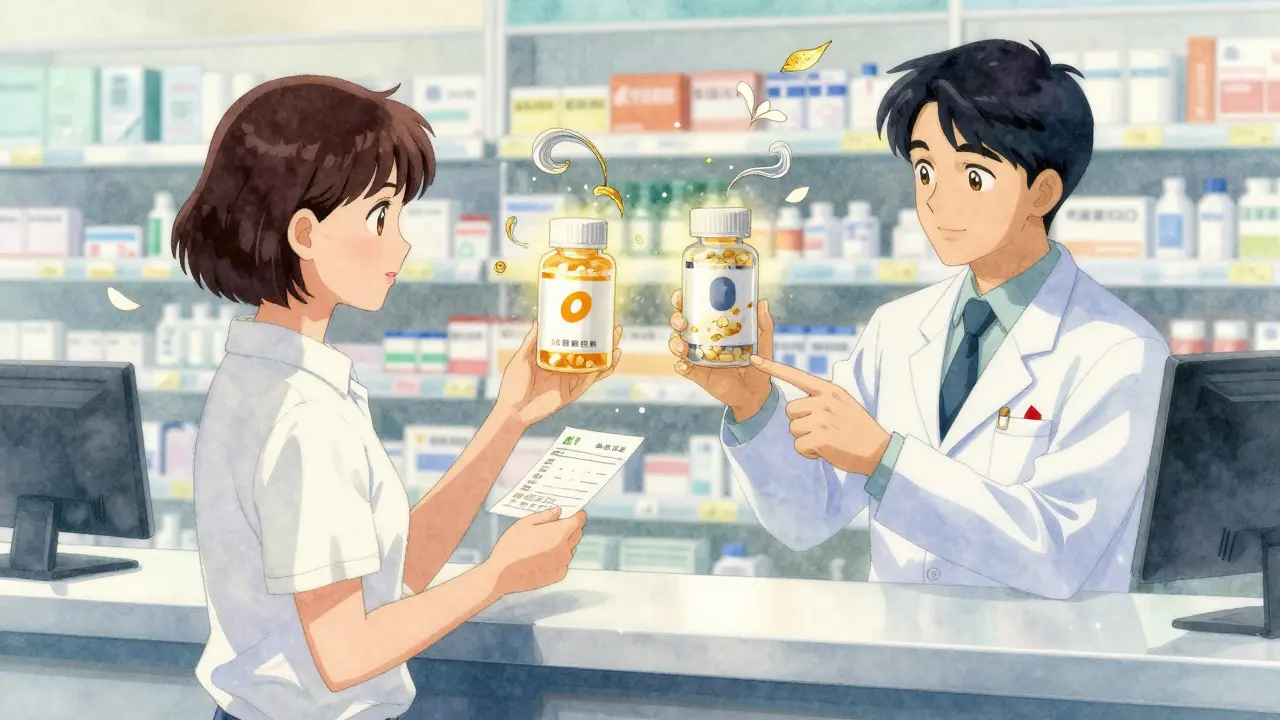
When you’re paying for prescriptions, every dollar counts. If you’re still paying full price for a medication you think should be cheaper, you’re not alone. Many people don’t realize that generics and authorized generics can cut their costs by 80% or more-but only if they know how to ask for them. The key isn’t just knowing they exist. It’s knowing how to talk to your pharmacist and insurance plan about the differences between them.
What’s the Difference Between Generic and Authorized Generic Drugs?
A generic drug is a copy of a brand-name medication that becomes available after the patent expires. It must contain the same active ingredient, work the same way in your body, and meet the same safety standards as the original. The FDA requires generics to be bioequivalent-meaning they deliver the same amount of medicine into your bloodstream within a very tight range (80-125% of the brand). Most generics are made by different companies, often overseas, and sold under a different name. An authorized generic is different. It’s made by the same company that produces the brand-name drug, often in the same factory, using the exact same formula and ingredients. But instead of selling it under the brand name, the company puts it on the market under a generic label-sometimes even the same packaging, just without the brand logo. Think of it like a store-brand version of a product made by the same company that makes the name-brand version. Why does this matter? Because even though they’re chemically identical, insurance plans and pharmacies treat them differently. That affects what you pay out of pocket.How Much Can You Really Save?
The numbers speak for themselves. In 2022, generic and biosimilar drugs saved the U.S. healthcare system over $408 billion. Over the past decade, that total reached $2.9 trillion. For individual patients, the savings are just as dramatic. After a brand-name drug loses its patent, prices usually drop by more than 75% within a year. Some drugs-like the HIV medication Truvada-saw prices fall from $50 per pill to just $3. That’s a 94% drop. But here’s the catch: list prices aren’t always what you pay. Your out-of-pocket cost depends on your insurance plan’s formulary, pharmacy benefit manager (PBM), and whether the generic is traditional or authorized. According to the Association for Accessible Medicines (AAM), 93% of generic prescriptions cost less than $20 in copays. For brand-name drugs? Only 59% do. The average generic copay is $6.16. The average brand-name copay? $56.12. Still, some patients pay more than expected-even for generics. Why? Because PBMs negotiate rebates with drugmakers, and those rebates don’t always translate into lower prices for you. Sometimes, an authorized generic has a lower list price than a traditional generic, but your plan puts it on a higher tier, so your copay stays the same.What to Say to Your Pharmacist (and When to Say It)
Most pharmacists know generics are cheaper. But many don’t know the difference between authorized and traditional generics-or how insurance handles them. That’s why you need to ask the right questions. Here’s exactly what to say:- “Is there a generic version of this medication?” This is your starting point. If the answer is yes, move on.
- “Is this an authorized generic?” Ask this even if they say yes to the first question. Some pharmacies don’t automatically offer AGs unless prompted.
- “How does my insurance treat authorized generics versus traditional generics?” This is the most important question. Some plans treat AGs like brand-name drugs. Others put them on the lowest tier. You won’t know unless you ask.
- “Can I switch between generic types to save money?” Sometimes, the same drug is available as both a traditional generic and an authorized generic. One might have a lower cash price or better copay.
Why Authorized Generics Can Be Trickier Than They Look
Authorized generics often have lower list prices than traditional generics. For example, authorized versions of drugs like Epclusa and Harvoni were priced 50-67% lower than the brand. But here’s the twist: because they’re made by the brand company, they sometimes don’t go through the same rebate negotiations as traditional generics. That means:- Your plan might not get a rebate on an authorized generic, so it doesn’t lower your copay.
- Your plan might put the authorized generic on a higher tier because it’s “still connected” to the brand.
- Some PBMs don’t even track authorized generics separately-so your pharmacist might not know the difference.
How to Compare Prices Yourself
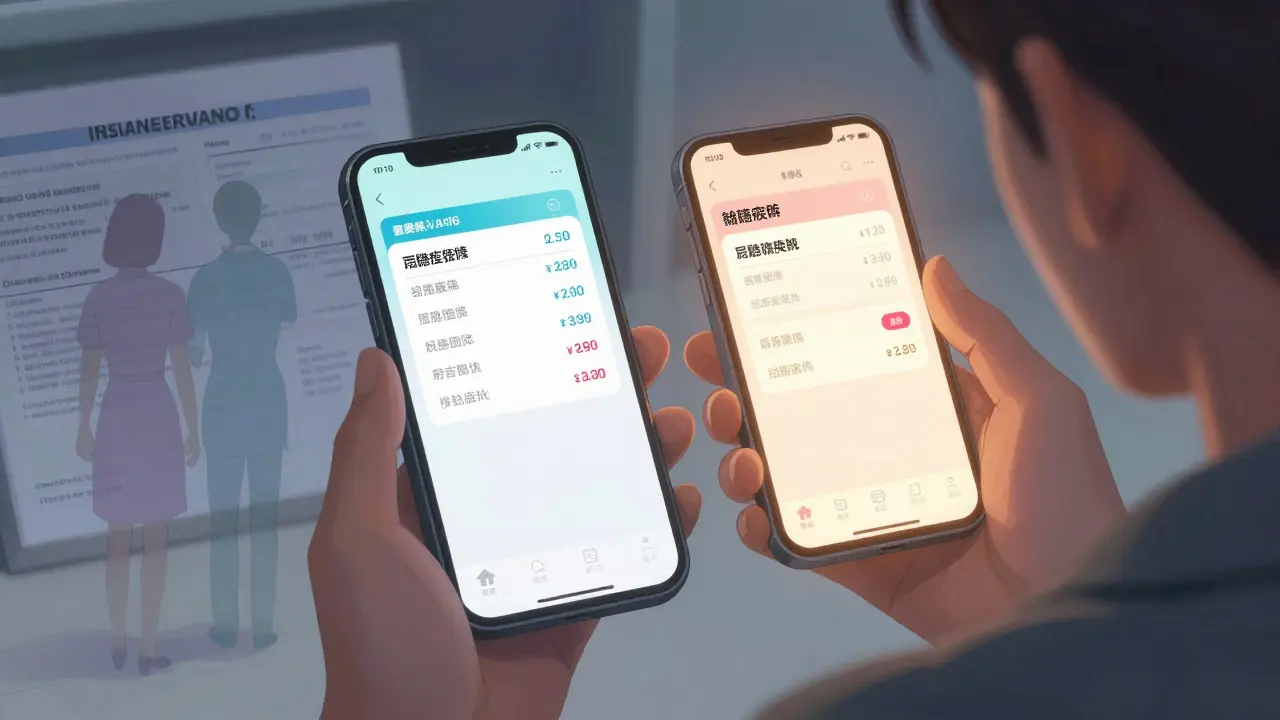
Insurance plans vary wildly. What works for one person won’t work for another. That’s why you need to check prices yourself. Use tools like GoodRx or SingleCare to compare cash prices for:- The brand-name drug
- The traditional generic
- The authorized generic

What If Your Plan Won’t Cover It?
If your insurance denies coverage or puts the generic on a high tier, you have options:- Ask your doctor for a prior authorization. Sometimes, just asking gets your plan to reconsider.
- Request a formulary exception. Most plans have a process to appeal coverage decisions.
- Use a patient assistance program. Many drugmakers offer discounts or free medication for low-income patients.
- Try a different pharmacy. Prices vary by location-even within the same city.
What About Biosimilars?
If you’re taking a biologic drug (like Humira, Enbrel, or insulin), you’re likely dealing with biosimilars instead of generics. These are highly similar-but not identical-copies of complex biologic medications. They’re newer, and prices are still coming down. In 2023, biosimilars saved over $7 billion, with average prices 50% lower than the original. Ask your doctor if a biosimilar is an option for you.Why This Matters Right Now
The FDA’s 2023 Drug Competition Action Plan is targeting hard-to-copy drugs like inhalers, skin creams, and injectables where generic competition has been slow. More approvals are coming. That means more savings ahead. But if you don’t ask, you won’t get them. Most patients don’t realize they have choices. They just accept what’s on the receipt. The truth? You have more power than you think. You can ask for generics. You can ask which kind. You can compare prices. You can switch pharmacies. You can appeal your plan. It takes a few minutes. But it could save you hundreds-or thousands-over the year.Are authorized generics as safe as traditional generics?
Yes. Both authorized generics and traditional generics are FDA-approved and must meet the same strict standards for safety, strength, quality, and performance. Authorized generics are made by the brand company in the same facility using the same formula. They’re not inferior-they’re just marketed under a different label.
Why is my copay the same for a brand and an authorized generic?
Your insurance plan may treat authorized generics the same as brand-name drugs because they’re made by the same company. Even if the list price is lower, your plan’s formulary might not reflect that. Always ask: “How does my plan treat this specific version?”
Can I switch from a brand to a generic without my doctor’s approval?
In most cases, yes. Pharmacists can substitute a generic for a brand-name drug unless the prescription says “dispense as written” or “no substitutions.” But if you want to switch between a traditional generic and an authorized generic, you may need to ask your pharmacist or doctor for clarification.
Do generics work as well as brand-name drugs?
Yes. The FDA requires generics to be bioequivalent, meaning they deliver the same amount of active ingredient into your bloodstream at the same rate as the brand. Studies consistently show no difference in effectiveness or side effects between generics and brand-name drugs.
What if my pharmacy doesn’t stock authorized generics?
Ask them to order it. Many pharmacies can get authorized generics within 1-2 days. If they say no, try another pharmacy. Prices and availability vary widely between locations. You can also check GoodRx to find nearby pharmacies that carry it.
Why don’t more people know about authorized generics?
Because drugmakers and insurers don’t always make it easy. Some brand companies used authorized generics to delay competition from traditional generics. While this practice is declining, many pharmacists still aren’t trained to explain the difference. Patients have to ask-and that’s how you take control.





John Cena
February 20, 2026 AT 04:43Been using generics for years. Never knew authorized ones existed until last month. My blood pressure med dropped from $42 to $11 just by asking. Pharmacist looked at me like I spoke alien. But hey, free money.
Laura B
February 21, 2026 AT 02:25This is so important. I had no idea my insulin was an authorized generic until I called my pharmacy. They didn’t even offer it unless I asked. Now I’m telling everyone I know. Seriously, people are overpaying because they don’t know to ask.
Irish Council
February 22, 2026 AT 06:10Pharmacies don’t tell you this because they profit from brand-name markups. PBMs are in bed with drugmakers. The whole system is rigged. You think you’re saving? You’re being played. Always pay cash. Always.
Tommy Chapman
February 24, 2026 AT 04:09Why do people think the government gives a damn about their prescription costs? You want to save money? Stop relying on insurance. Pay cash. Use GoodRx. Stop whining. America’s not your pharmacy.
Jayanta Boruah
February 25, 2026 AT 11:34The concept of authorized generics is fundamentally misunderstood by the lay public. It is not merely a marketing strategy but a strategic regulatory arbitrage mechanism deployed by vertically integrated pharmaceutical conglomerates to suppress market entry by third-party generic manufacturers. The FDA’s bioequivalence thresholds, while ostensibly rigorous, are statistically permissive and do not account for pharmacokinetic variability in subpopulations. Therefore, the assumption of interchangeability is epistemologically flawed.
Furthermore, the PBM rebate system is a perverse incentive structure wherein the nominal list price is artificially inflated to maximize rebate extraction, while the patient’s out-of-pocket cost remains invariant. This is not a market failure-it is a designed outcome.
It is therefore imperative that patients, armed with institutional knowledge and access to pricing transparency tools, become active participants in pharmaceutical supply chain governance. The moral hazard of passive consumption must be replaced with vigilant, informed demand.
James Roberts
February 26, 2026 AT 05:35Wow, someone actually wrote a useful post for once. Like, not one of those ‘just take vitamins’ nonsense threads. I’m impressed. You’re basically the pharmacist we all wish we had on speed dial.
Also, the fact that authorized generics are sometimes priced higher by insurance? That’s not a glitch-it’s a feature. PBMs are just middlemen who get paid to make things confusing. If you want to save, you gotta outsmart them. And you just did.
aine power
February 27, 2026 AT 18:43Pathetic. You’re telling people to ask? That’s your solution? Weak.
Freddy King
February 28, 2026 AT 01:39Let me break this down like I’m talking to a toddler with a formulary: PBMs don’t care about you. They care about rebates. Authorized generics? They’re the ‘premium generic’-same pill, different label, same copay because your plan doesn’t want to admit it’s a brand in disguise. It’s a shell game. And you? You’re the sucker holding the empty cup.
Pro tip: Cash price > insurance copay 70% of the time. Always check GoodRx first. Then ask your pharmacist if they have the AG. If they look confused? That’s your cue to go to a different pharmacy.
Michaela Jorstad
February 28, 2026 AT 09:26This is so helpful! I just switched my cholesterol med from brand to authorized generic and saved $68/month. I didn’t even know I could ask for it! I’m so glad I read this. Thank you for breaking it down so clearly. I’m sharing this with my mom and my sister.
Also-please, please, please ask your pharmacist for the cash price. Even if you have insurance. I paid $18 cash for a generic that my insurance said was $35. Mind blown.
Davis teo
February 28, 2026 AT 20:11OMG I JUST REALIZED I’VE BEEN OVERPAYING FOR MY ANTIBIOTIC FOR 3 YEARS?? I’M SO MAD. WHY DIDN’T ANYONE TELL ME?? I’M TELLING MY ENTIRE FAMILY NOW. THIS CHANGED MY LIFE. I’M CRYING. THANK YOU.
Jana Eiffel
March 1, 2026 AT 06:37The moral imperative underlying pharmaceutical accessibility is not merely economic, but ontological: the right to health is inalienable, yet commodified under a regime of corporate capture. The authorized generic, as a liminal category, exposes the epistemological dissonance between regulatory compliance and distributive justice.
When the FDA permits bioequivalence within a 20% margin, it tacitly endorses therapeutic uncertainty. The patient, deprived of transparent pricing mechanisms, becomes an unwitting participant in a system where cost is deliberately obfuscated to preserve profit margins.
Thus, the act of inquiry-of asking-is not merely pragmatic, but revolutionary. It is the quiet rebellion of the embodied subject against the algorithmic indifference of the PBM.
John Cena
March 2, 2026 AT 02:51Wait, so if an authorized generic is made by the same company, why does insurance treat it like a brand? That’s wild. I just assumed ‘generic’ meant ‘cheaper’ full stop.
So if I switch from an authorized to a traditional one, could I actually save more? I’m going to call my pharmacy tomorrow.
Laura B
March 3, 2026 AT 08:52YES. Exactly. My mom did that. She was paying $50 for the authorized version of her diabetes med. Switched to the traditional generic-same active ingredient, same manufacturer (just different label)-and paid $12. The pharmacist didn’t even know she could do that until she asked.
Just say: ‘I heard there’s a traditional generic available. Can you check if it’s cheaper?’ They’ll look it up. It’s not hard.
Chris Beeley
March 3, 2026 AT 13:12You think this is new? I’ve been doing this since 2018. I work in pharma logistics. The whole ‘authorized generic’ thing was invented by big pharma to keep generics from undercutting them. They’d release an AG at a lower price, then quietly raise the brand price. Patients thought they were saving. They weren’t. They were being groomed.
Now? The AGs are getting cheaper. But only because the FDA is finally cracking down on anti-competitive behavior. It’s not about you asking. It’s about regulation catching up.
James Roberts
March 4, 2026 AT 13:05So you’re saying the system is designed to make you feel smart for asking… but really, you’re just doing the work they should’ve done for you?
Yup. Welcome to American healthcare. You’re not a patient-you’re a customer service rep for Big Pharma.