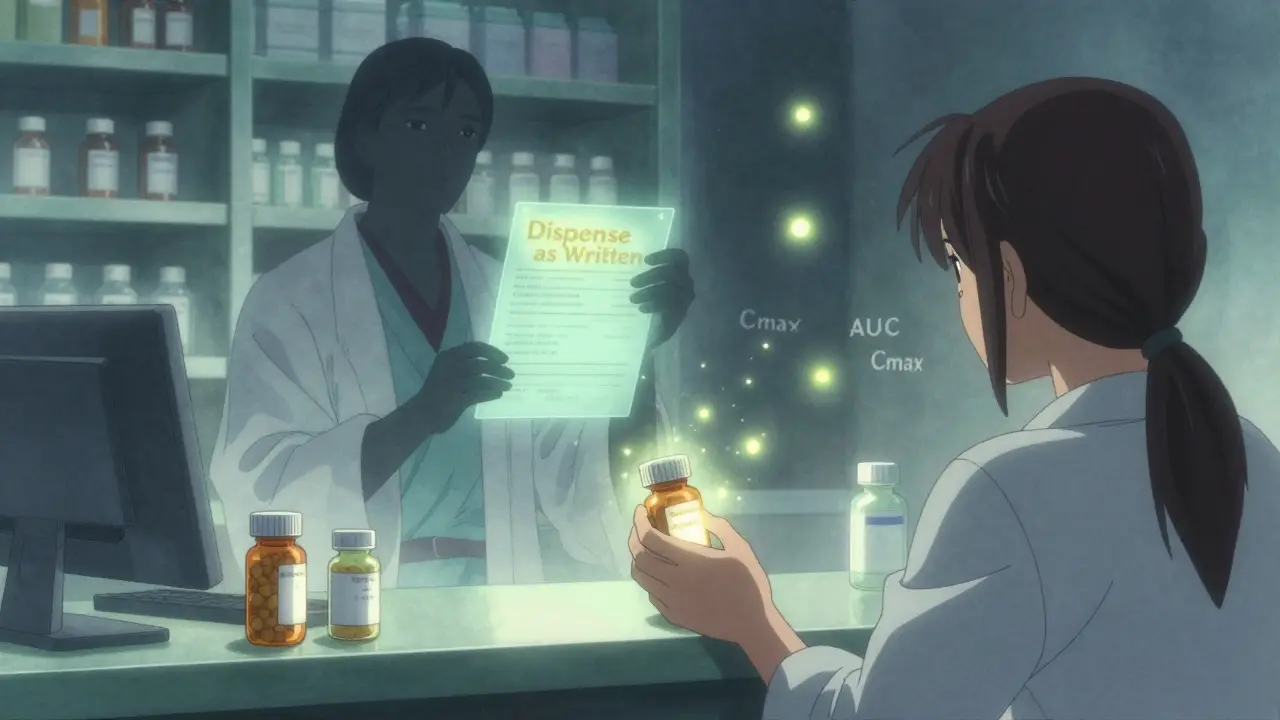
When your pharmacist hands you a pill bottle with a different name than what your doctor wrote, it’s not a mistake. It’s generic substitution-a common practice where your insurance company or pharmacy swaps your brand-name drug for a cheaper, FDA-approved generic version. For most people, it’s a simple, safe cost-saver. But for others, it can trigger confusion, side effects, or even dangerous gaps in care. Understanding how insurance requirements work around this process isn’t just helpful-it’s necessary to avoid surprises at the pharmacy counter.
What Exactly Is Generic Substitution?
Generic substitution means replacing a brand-name drug with a generic version that has the same active ingredient, strength, dosage form, and route of administration. The FDA requires generics to be bioequivalent, meaning they deliver the same amount of medicine into your bloodstream at the same rate as the brand. That’s measured by two key metrics: AUC and Cmax. The acceptable range? Between 80% and 125% of the brand’s performance. That’s not a guess-it’s a strict scientific standard. But here’s the catch: bioequivalence doesn’t mean identical. Generics can have different inactive ingredients-fillers, dyes, preservatives. For most people, that’s no big deal. But for someone with allergies, sensitivities, or conditions like epilepsy or thyroid disease, even tiny differences can throw off their balance. A 2023 review of over 6,000 patient reviews on Drugs.com found that 24% of complaints were about unexpected reactions after switching to a different generic manufacturer. Same active ingredient. Different pill. Different result.How Insurance Companies Push Generic Use
Insurance companies don’t just encourage generic substitution-they often force it. Most private insurers, like Blue Cross, Aetna, and UnitedHealthcare, have mandatory generic programs. If you pick a brand-name drug when a generic is available, you pay the difference out of pocket. For example, if your brand-name drug costs $150 and the generic is $30, your copay might be $30… but you’ll be billed $120 extra. That’s not a discount. It’s a penalty. In Canada, Sun Life Financial and Great West Life started mandatory substitution in 2011-2012. They reported brand-name claims averaged $72, while generics were just $27-a 62.5% drop in cost. In the U.S., generics make up 90% of all prescriptions but only 18% of total drug spending. That’s $373 billion saved annually, according to the Association for Accessible Medicines. That’s real money. But who’s paying the price?State Laws Vary-A Lot
You can’t rely on federal rules alone. Each state has its own laws about when and how pharmacists can substitute generics. In 19 states, pharmacists are legally required to substitute unless the doctor says no. In 7 states and Washington, D.C., they must get your explicit consent before swapping. In 31 states, they just have to tell you they did it-no permission needed. Texas has one of the clearest rules: three conditions must all be met before substitution can happen:- The generic must cost you less than the brand.
- You haven’t refused the switch.
- Your doctor didn’t write “Dispense as Written” or “Brand Medically Necessary” on the prescription.

When Brand-Name Drugs Are Medically Necessary
Not all drugs are created equal. For medications with a narrow therapeutic index-like warfarin, lithium, levothyroxine, or certain anti-seizure drugs-even small changes in blood levels can cause serious problems. That’s why doctors sometimes write “Dispense as Written” on the prescription. That’s your legal shield. But here’s the problem: many patients don’t know what those words mean. Or worse, their doctor writes them, but the pharmacist ignores them. A 2022 study found that 37% of negative patient reports involved substitutions despite “Dispense as Written” being clearly marked. If you’re on one of these sensitive drugs and your insurance forces a switch, you need to act. Your doctor must submit a letter of medical necessity to your insurer. For Blue Cross Blue Shield of Michigan, that means providing ICD-10 codes showing you had a bad reaction or failed to stabilize on the generic. Their approval rate? 78%. But each insurer has different rules. Aetna wants three clinical criteria. UnitedHealthcare wants five. It’s confusing. And time-consuming.How to Fight Back-Without Paying More
You have rights. Here’s how to use them:- Ask your doctor to write “Dispense as Written” or “Brand Medically Necessary” on the prescription. This is the most direct way to block substitution. It’s legal in every state.
- Call your insurance company. Ask for their prior authorization form for brand-name drugs. Fill it out with your doctor’s help. Attach lab results, previous adverse reactions, or dosage instability records.
- Speak to your pharmacist. Ask if the generic you’re being given is from the same manufacturer as before. If it changed, ask for the old one. Some pharmacies will honor that request, especially if you’ve had issues.
- Check your Explanation of Benefits (EOB). If you were charged extra for a brand-name drug you didn’t ask for, dispute it. You may be owed a refund.
Biosimilars Are a Different Ballgame
If you’re on a biologic-like Humira, Enbrel, or insulin-the rules change again. These aren’t small molecules. They’re complex proteins made from living cells. The FDA calls them “biosimilars,” not generics. They’re not exact copies. They’re “highly similar.” As of late 2023, only 38 biosimilars have been approved in the U.S. compared to over 10,000 small-molecule generics. And substitution? In 38 states, pharmacists can’t swap them without your doctor’s approval. In 27 states, you must give separate consent. And in 45 states, pharmacists must notify your doctor within five days if they switch you. This isn’t just red tape. It’s safety. A bad substitution on a biologic can mean hospitalization.
What You Can Do Today
You don’t need a lawyer or a PhD to protect yourself. Here’s your checklist:- If you’re on thyroid, epilepsy, blood thinners, or psychiatric meds-ask your doctor to write “Dispense as Written” on every prescription.
- Keep a list of which generic manufacturer you’ve used before and how you reacted to it.
- When you pick up a refill, check the label. Is the manufacturer different? If so, ask if it’s the same one you’ve been taking.
- Don’t assume “generic” means “safe for me.” If you feel different after a switch, get bloodwork done.
- Know your insurance’s policy. Call them. Ask: “Do you have a mandatory generic substitution program? What’s the process to get an exception?”
Why This Matters Beyond Money
The goal of generic substitution isn’t to hurt patients. It’s to make healthcare affordable. And for most people, it works. But healthcare isn’t one-size-fits-all. A system that saves $373 billion a year can still break someone’s life if it ignores individual biology. The real issue isn’t generics themselves. It’s lack of transparency. Patients are often left in the dark. Pharmacists are pressured to switch. Doctors are overwhelmed by paperwork. Insurance companies don’t always communicate clearly. You don’t have to accept silence. You have the right to know what you’re taking. You have the right to refuse a switch. And you have the right to ask for the brand if your health depends on it.Can my pharmacist substitute my brand-name drug without telling me?
In 31 U.S. states and Washington, D.C., pharmacists must notify you if they substitute a generic drug, even if you didn’t give permission. But in 19 states, they’re required to substitute without asking-unless your doctor says “Dispense as Written.” In the remaining states, notification rules vary. Always check your prescription label and ask if a change was made.
What does “Dispense as Written” mean on a prescription?
“Dispense as Written” (or “DAW”) means your doctor has requested that the pharmacy give you exactly what’s written on the prescription-no substitutions. This is legally binding in all 50 states. If a pharmacist ignores it, they could face liability. Always make sure this phrase is clearly written or checked on your prescription.
Why do I react differently to different generic brands?
Generic drugs must have the same active ingredient as the brand, but they can use different inactive ingredients-like fillers, dyes, or coatings. For most people, this doesn’t matter. But for those with sensitivities, allergies, or conditions like epilepsy or thyroid disease, these differences can affect absorption or cause side effects. If you notice changes after switching generics, talk to your doctor and ask to stick with the same manufacturer.
Can I get my brand-name drug covered if the generic doesn’t work?
Yes. Most insurance plans allow exceptions through a “prior authorization” process. Your doctor must submit documentation showing you tried the generic and had a negative outcome-like unstable lab results, side effects, or loss of symptom control. Approval rates vary, but many insurers approve 70-80% of medically justified requests. Keep records of your symptoms and lab values to strengthen your case.
Are biosimilars the same as generics?
No. Generics are exact copies of small-molecule drugs. Biosimilars are highly similar to complex biologic drugs made from living cells, but not identical. They require more testing and cannot be automatically substituted in most states. You usually need your doctor’s approval and sometimes your consent before being switched to a biosimilar.



Thomas Anderson
December 16, 2025 AT 19:07Just got my levothyroxine refill and noticed the pill looks different. Asked the pharmacist-yep, switched manufacturers. Didn’t feel any different, but now I’m checking the label every time. Good reminder to ask.
Rich Robertson
December 18, 2025 AT 12:56Been on warfarin for 12 years. Switched generics once-INR spiked to 4.8. Ended up in the ER. Now I insist on the same brand every time. Insurance doesn’t care, but my blood does. Tell them ‘Dispense as Written’-it’s your legal right, not a favor.
Sarthak Jain
December 19, 2025 AT 12:12bro i had the same thing with my seizure med. switched to generic and started having mini seizures at work. doc had to fight insurance for 3 months to get me back on brand. they said ‘it’s the same chemical’-but your body ain’t a lab report.
Daniel Wevik
December 19, 2025 AT 19:12For anyone on narrow-therapeutic-index drugs: document everything. Lab values, symptoms, dates. When you file for prior auth, attach a spreadsheet. Insurers respond to data, not stories. I got my Humira biosimilar exception approved in 11 days because I had 18 months of records. You’re not being difficult-you’re being smart.
Dwayne hiers
December 21, 2025 AT 09:59Let’s clarify bioequivalence: 80–125% AUC/Cmax doesn’t mean ‘close enough.’ It means the 90% confidence interval of the ratio falls within that range. For drugs like levothyroxine, even a 10% shift in absorption can alter TSH by 2–3 mIU/L. That’s not noise-it’s clinically significant. Pharmacists aren’t trained to interpret PK data, but you should know your drug’s margin of error.
The FDA’s Orange Book rating ‘A’ means therapeutic equivalence is *statistically* demonstrated, not that all patients will respond identically. That’s why DAW1 is critical. It’s not bureaucracy-it’s pharmacovigilance.
And yes, inactive ingredients matter. Povidone, lactose, titanium dioxide-these aren’t inert. For patients with IBS, celiac, or dye allergies, they’re triggers. Generic manufacturers aren’t required to disclose excipient sources. You have a right to ask.
Insurance mandates exist because pharmacy benefit managers (PBMs) profit from generic dispensing. They get rebates from manufacturers. That’s why you’re pressured to switch even when it’s unsafe. Your doctor’s ‘Dispense as Written’ is the only firewall.
Don’t wait for a crisis. If you’re on lithium, phenytoin, or cyclosporine, demand a written prescription note *now*. Keep a copy. Show it to every pharmacist. If they refuse, file a complaint with your state board of pharmacy. It’s not aggressive-it’s necessary.
And biosimilars? They’re not generics. They’re complex biologics with different glycosylation patterns. A 2021 JAMA study showed 14% of patients switching from adalimumab to a biosimilar developed neutralizing antibodies. That’s not theoretical. That’s real immune response.
Knowledge is power. But power without action is noise. Advocate. Document. Push back. Your life isn’t a cost center.
Daniel Thompson
December 22, 2025 AT 02:13As a former claims analyst for UnitedHealthcare, I can tell you that the ‘mandatory substitution’ policy is not driven by clinical need but by rebate structures negotiated between PBMs and generic manufacturers. The patient’s experience is an afterthought. We were incentivized to deny prior auths unless the documentation met rigid criteria-often ignoring clinical nuance. I left the industry because I couldn’t justify it.
Doctors are pressured too. Many don’t know the state laws. They assume ‘generic’ means ‘safe.’ They don’t realize that for some patients, switching can mean hospitalization. The system is broken, not because generics are bad-but because profit is prioritized over precision medicine.
If you’re on a sensitive drug, don’t rely on your doctor to fight for you. Do it yourself. Call your insurer. Ask for the form for ‘non-formulary exception.’ Submit lab results. Write a letter. It takes 20 minutes. It could save your life.
Jonny Moran
December 22, 2025 AT 12:04My mom’s on levothyroxine. Switched generics last year-she got dizzy, gained 15 lbs, and her depression got worse. We called the pharmacy. They said ‘it’s the same drug.’ We called the doctor. He said ‘it’s supposed to be.’ We called insurance. They said ‘it’s cheaper.’ We called the FDA’s MedWatch line. They said ‘report it.’ We did. Two months later, they approved her brand-name exception. She’s back to normal. Don’t give up. Your voice matters.
Rulich Pretorius
December 23, 2025 AT 15:00It’s not about generics versus brand-it’s about control. Who decides what you take? The pharmacist? The insurance algorithm? Or you, with your doctor’s guidance? The erosion of patient autonomy in this process is quietly dangerous. We’ve outsourced medical decisions to cost models, and now we’re surprised when people break. The body doesn’t obey spreadsheets. Your physiology is not a line item. This isn’t just about pills-it’s about dignity.
When you ask for the same manufacturer, you’re not being difficult. You’re reclaiming agency. When you document your reaction, you’re adding to the evidence base. When you challenge the system, you’re not alone. There are thousands of us. We’re just tired of being silent.
Edward Stevens
December 23, 2025 AT 15:47So let me get this straight: the system saves $373 billion a year… by making people sick enough to go to the ER, then billing them for it? That’s not efficiency. That’s financial judo. Insurance companies don’t care if you’re stable-they care if your drug costs less than $30. If you’re lucky, your doctor has time to fight. If you’re not? You’re just another data point in a quarterly report.
Meanwhile, the CEO of Blue Cross just got a $12 million bonus. Coincidence? I think not.
Tim Bartik
December 24, 2025 AT 14:50Y’all act like this is some new scam. Nah. This is America. They got a pill for everything, then charge you extra if you don’t take the cheap one. If you want the good stuff? Pay up. If you’re poor? Hope you don’t have a thyroid. Welcome to the land of the free and the home of the deductible.
My cousin got switched to some generic seizure med and had a seizure in front of her kid. Insurance said ‘oops, our bad.’ Then sent her a $20 coupon for CVS. F*ck that. This ain’t a coupon culture-it’s a life-or-death game.
Wade Mercer
December 24, 2025 AT 22:14People who complain about generic substitution are just lazy. If you can’t handle a slightly different pill, maybe you shouldn’t be on medication at all. The system works for 95% of people. Stop being a drama queen and take the generic like everyone else. Your ‘special needs’ are just an excuse to get more expensive drugs.
jeremy carroll
December 26, 2025 AT 08:21just wanted to say-this post saved my life. i was about to let them switch my lithium and i didn’t even know i should’ve been scared. now i’m keeping a log, asking about manufacturers, and even printed out the ‘dispense as written’ thing to give my doc. thanks for not just talking about money-actually talking about people.