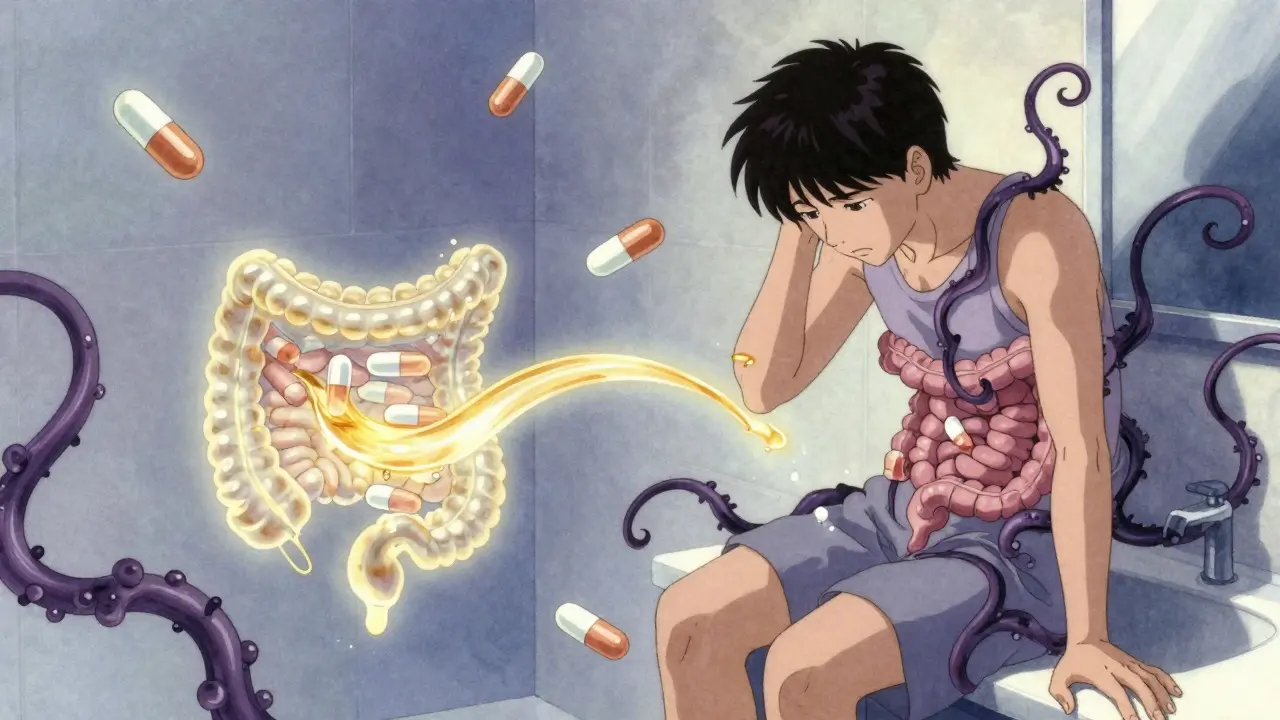
When you start taking opioids for chronic pain, you’re told to watch for nausea, drowsiness, or dizziness. But few warn you about the one side effect that can ruin your daily life: opioid-induced constipation. It’s not just a minor inconvenience. For up to 95% of people on long-term opioid therapy, it’s a persistent, painful, and often untreated problem that makes people quit their pain meds altogether-even when the pain is under control.
Unlike regular constipation, OIC doesn’t get better with time. It doesn’t respond well to the usual fixes like prunes or fiber supplements. And because it’s caused by how opioids interact with your gut-not just slowing things down-it needs a completely different approach.
Why Opioid-Induced Constipation Is Different
Opioids bind to receptors in your intestines, which shuts down the natural movement of your bowel. Your stomach slows down. Your pancreas and liver stop releasing fluids. Your colon sucks up more water from stool, turning it hard and dry. This isn’t just sluggish digestion-it’s a full system shutdown.
That’s why eating more fiber, which works for most people with occasional constipation, can make OIC worse. Fiber ferments in a slow-moving gut, creating gas, bloating, and even dangerous fecal impactions. The American Pain Society and the American Gastroenterological Association both warn against high-fiber diets for OIC patients-especially without other treatments in place.
Studies show that 50% to 75% of people using over-the-counter laxatives like MiraLAX or Senokot still struggle with OIC. That’s because these laxatives don’t fix the root cause: opioid receptors stuck in your gut.
What Works: First-Line Treatments
Before you reach for a bottle of laxatives, start with a plan. The first step is prevention. If you’re starting opioids, talk to your doctor about bowel management before the first pill.
Here’s what actually works as a first-line approach:
- Polyethylene glycol (PEG 3350) - Also sold as MiraLAX. Dose: 17-34 grams daily. It pulls water into the colon without irritating the gut. It’s safe for long-term use and doesn’t cause cramping like stimulants.
- Bisacodyl - A stimulant laxative. Dose: 5-15 mg daily. Works faster than PEG, but can cause cramps if overused.
- Senna - Another stimulant. Dose: 8.6-17.2 mg daily. Often combined with PEG for better results.
Doctors should assess your bowel function before starting opioids using tools like the Bristol Stool Form Scale or the OIC Severity Scale. If you’re already constipated before the opioid starts, you’re already behind. That’s why baseline tracking matters.
Monitor yourself weekly. If you’re not having a bowel movement at least every 2-3 days, it’s time to adjust. Don’t wait until you’re in pain or bloated. Increase the dose of your laxative by 25-50% every 3-7 days until you get results.

Prescription Options When Laxatives Fail
If you’ve tried PEG, senna, and bisacodyl-and you’re still stuck-your next step is a prescription drug designed specifically for OIC: peripherally acting μ-opioid receptor antagonists (PAMORAs).
These drugs block opioid receptors in your gut but don’t cross the blood-brain barrier. That means they relieve constipation without taking away your pain relief.
Here are the three main ones:
Methylnaltrexone (Relistor®)
- How it works: Injected under the skin. Starts working in as little as 30 minutes.
- Best for: Patients in palliative care or advanced illness.
- Downsides: Injection site reactions (47% of users report redness or pain), cost ($800-$1,200/month), and not approved for non-palliative patients.
- Real-world feedback: 32% of users on Drugs.com say relief comes within 4 hours. But 65% complain about price.
Naloxegol (Movantik®)
- How it works: Oral tablet, taken once daily on an empty stomach.
- Best for: Chronic non-cancer pain patients.
- Downsides: Can cause abdominal pain, nausea, or diarrhea. Avoid if you’re on strong CYP3A4 inhibitors like ketoconazole.
- Real-world feedback: 40-50% of patients see improvement in bowel movements within a week. Higher satisfaction than OTC laxatives.
Naldemedine (Symcorza®)
- How it works: Daily oral tablet. Approved for adults and children as young as 18 months (since March 2023).
- Best for: Broad use in chronic pain patients, including those on long-term opioids.
- Downsides: Abdominal pain in 38% of users. May interact with strong CYP3A4 inducers like rifampin.
- Real-world feedback: 6.8/10 average rating on Drugs.com. 59% report moderate to significant improvement.
Lubiprostone (Amitiza®)
- How it works: Activates chloride channels in the gut to increase fluid secretion.
- Best for: Women with OIC (initially approved only for women due to trial limitations, though it works in men too).
- Downsides: Nausea in 30% of users, diarrhea in 15-20%. Not recommended if you have a bowel obstruction.
- Real-world feedback: Effective, but side effects cause many to stop taking it.
Why So Many People Are Still Untreated
Despite all these options, only 15-30% of patients on opioids get proper OIC prevention, according to clinical studies. Why?
Many doctors don’t screen for it. Some think it’s “just constipation” and don’t realize it needs special treatment. Others assume patients will speak up-but most don’t. They’re embarrassed. Or they think it’s normal.
Patients report the same thing over and over: trial and error. One person on Reddit said they tried six different laxatives before their doctor finally prescribed Movantik. Another said they stopped their opioid because they couldn’t go to the bathroom for five days.
And cost is a huge barrier. PAMORAs can cost $500-$1,200 a month. Most insurance companies make you try cheaper laxatives first-step therapy. Even then, many deny coverage unless you’ve documented failed attempts.

What You Can Do Right Now
If you’re on opioids and constipated:
- Stop increasing fiber. It’s not helping-and could be making things worse.
- Start with PEG (MiraLAX). Take 17g daily. If no result in 3 days, increase to 34g.
- Add senna or bisacodyl. If PEG alone isn’t enough, combine it with one stimulant laxative.
- Track your bowel movements. Use a simple log: date, time, stool consistency (use Bristol Scale), and symptoms.
- Ask your doctor about PAMORAs. Don’t wait until you’re in agony. If you’ve tried two laxatives for 2 weeks with no relief, it’s time.
Also, ask if your clinic uses standardized OIC assessment tools. Only 45% of primary care providers do. If they don’t, bring the Bristol Stool Scale with you. It’s free, simple, and proven.
The Bigger Picture
OIC isn’t going away. Over 100 million Americans got opioid prescriptions in 2022. About half of them will develop OIC. The market for treatments is growing fast-projected to hit $3.4 billion by 2028.
But progress is slow. New combination therapies are in trials-like naloxone with PEG-designed to give you the benefits of both in one pill. The FDA could approve one as early as mid-2024.
Meanwhile, the biggest risk isn’t side effects. It’s stopping your pain medication because you can’t manage your bowels. Studies show 30-40% of patients reduce or quit opioids because of uncontrolled constipation-even when their pain is well managed.
That’s the real tragedy. You shouldn’t have to choose between pain relief and being able to go to the bathroom.
There are solutions. You just need to ask for them.



Catherine Scutt
January 7, 2026 AT 18:38I tried everything-prunes, flaxseed, even that weird colon cleanse tea. Nothing worked. Then I read somewhere that fiber makes OIC worse? Mind blown. I was doing everything wrong. Started PEG and boom, regular again. Why does no one tell you this?!
Darren McGuff
January 9, 2026 AT 09:42Oh my god, YES. I was on oxycodone for three years after my back surgery. Constipation was a nightmare-I’d go five days without a BM. My GP just handed me a bottle of Dulcolax like it was Advil. I almost quit the meds because I was terrified to leave the house. Then my GI specialist said, ‘You’re not broken, your gut is hijacked.’ Movantik changed my life. No more panic attacks before dinner. Worth every penny.
Alicia Hasö
January 11, 2026 AT 08:05Let me say this clearly: Opioid-induced constipation isn’t just ‘a side effect’-it’s a medical emergency waiting to happen. You’re not being dramatic if you’re in pain, bloated, or terrified to eat. And no, ‘just drink more water’ isn’t a solution. The science is clear: PAMORAs are the gold standard when OTC fails. If your doctor doesn’t know what Relistor or Naldemedine are, find a new one. Your quality of life matters more than their outdated assumptions. Bring this article. Print it. Stick it on their desk. You deserve pain relief without suffering in silence.
Drew Pearlman
January 11, 2026 AT 14:12Okay, I’ve been on long-term fentanyl patches for 8 years and I’ve tried it all. PEG? Yeah, that’s my daily bread now. Senna? I take it every other day to keep things moving. But honestly? The real game-changer was learning to track my stool with the Bristol Scale. I started a little notebook-date, time, shape, how I felt. It sounds silly, but it gave me back control. And when I finally asked for Movantik, my doctor actually listened. Took three months of paperwork and three denials from insurance, but I won. Now I’m not just surviving-I’m living. Don’t give up. Your bowels are worth fighting for.
Patty Walters
January 12, 2026 AT 04:03ugh i tried miralax for weeks then switched to senokot and my stomach felt like it was gonna explode. i thought i was doing it right but turns out i was just making it worse. then my aunt told me about naldemedine-she’s on it for her arthritis pain. took me 2 months to get it covered but now i go every day without crying. dont be afraid to ask for the rx ones. theyre not magic but theyre real.
Phil Kemling
January 13, 2026 AT 23:48There’s something deeply ironic here. We’ve created drugs that can silence the most intense human pain, yet we’ve built a system that ignores the most basic, biological consequence of using them. The body isn’t a machine you can override with chemicals and hope for the best. It’s a conversation-between neurons, receptors, fluids, and time. When we silence the gut’s voice with opioids, we don’t just slow digestion-we silence a part of ourselves. The real tragedy isn’t the constipation. It’s that we’ve normalized ignoring the body’s cries until it screams too loudly to be ignored.
Diana Stoyanova
January 15, 2026 AT 06:56Y’ALL. I’m a 34-year-old mom on chronic pain meds. I had to choose between crying in the bathroom for 45 minutes or going to work. I was so ashamed. Then I found this subreddit and read about PEG + senna. I started yesterday. I had a BM this morning. I cried again-but this time from relief. To anyone reading this: you’re not lazy. You’re not broken. You’re just on opioids. And there’s help. Don’t wait until you’re hospitalized. Ask for PAMORAs. Bring this post to your doctor. You’re not asking for a favor-you’re asking for your dignity back. And you deserve it.
Elisha Muwanga
January 15, 2026 AT 22:36Why are we giving out these expensive prescription drugs like candy? People just need to eat more fiber, drink water, and stop being so lazy. This is America-get off the opioids and deal with your pain like a grown-up. These drugs are for addicts anyway. If you can’t go to the bathroom, maybe you shouldn’t be on them. Taxpayer money shouldn’t fund people who can’t take basic responsibility for their health.