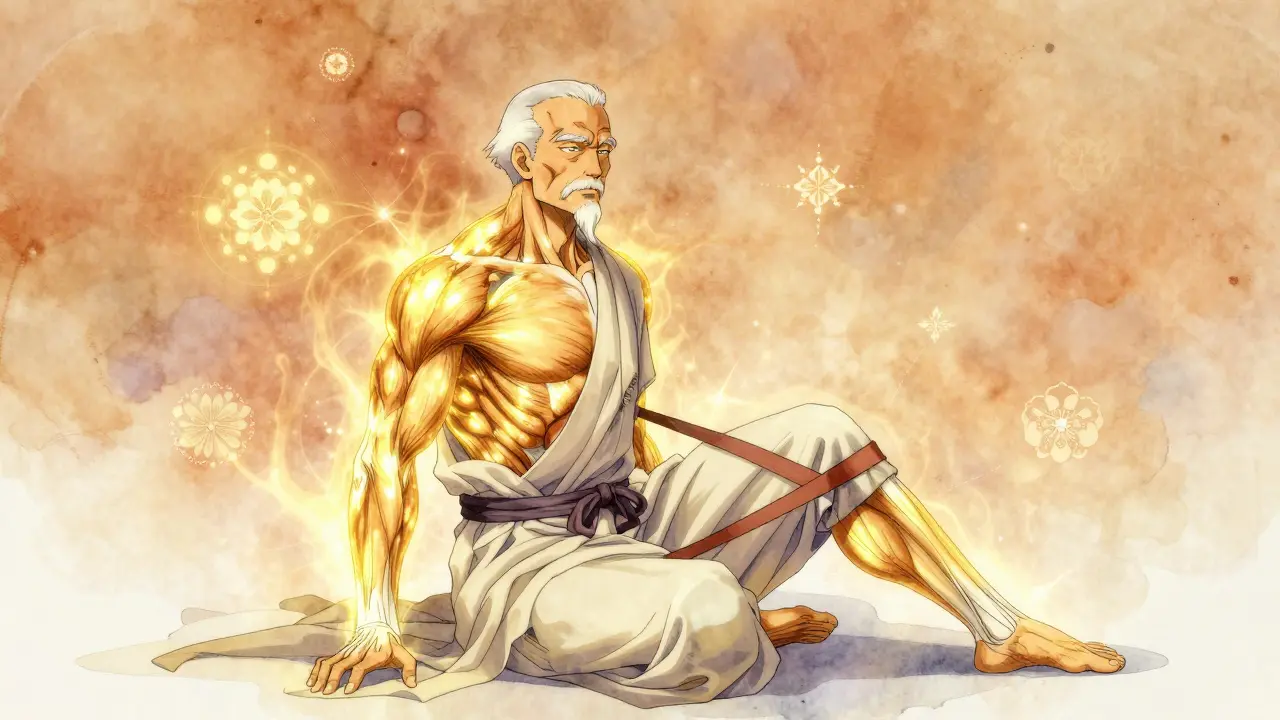
By the time you hit your 40s, your body is already losing muscle - slowly, quietly, and often without you noticing. It’s not just about getting weaker. It’s about losing the ability to stand up from a chair, climb stairs, or carry groceries. This isn’t normal aging. It’s sarcopenia - the progressive loss of muscle mass, strength, and function that starts in your 30s and accelerates after 65. Left unchecked, it increases your risk of falls, fractures, hospital stays, and even early death. But here’s the good news: you can fight it. And the most powerful tool you have is strength training.
What Exactly Is Sarcopenia?
Sarcopenia isn’t just feeling a little weaker as you get older. It’s a medical condition defined by two things: loss of muscle mass and loss of physical function. The European Working Group on Sarcopenia in Older People (EWGSOP) set the standard in 2018 and updated it again in 2023. To be diagnosed, you need both low muscle mass and low strength or slow walking speed.
By age 60, about 1 in 10 adults have sarcopenia. By 80, that jumps to nearly half. In the U.S. alone, it costs $18.5 billion a year in healthcare. The numbers don’t lie - this is a growing public health crisis.
What’s happening inside your muscles? Your body loses motor neurons - the signals from your brain that tell muscles to move. After 60, you lose 3-5% of these every year. Fast-twitch muscle fibers, the ones that give you power for quick movements like standing up or catching yourself, shrink by 30-40% by age 80. Your muscles also become worse at repairing themselves. Satellite cells, which help rebuild muscle, drop by 50-60% by age 70. And inflammation creeps in, making it harder for your body to build and keep muscle.
How Is Sarcopenia Different From Other Muscle Problems?
People often confuse sarcopenia with other types of muscle loss, but they’re not the same.
General muscle atrophy happens when you stop using your muscles - like after being bedridden. You can lose 1-1.5% of muscle mass per day in that situation. Sarcopenia is different. It happens even if you’re active. It’s driven by aging biology, not just inactivity.
Cachexia is muscle loss caused by serious illness - cancer, heart failure, kidney disease. It comes with weight loss, fatigue, and metabolic chaos. Sarcopenia doesn’t involve those systemic changes. It’s isolated to muscle decline.
Dynapenia is just strength loss without muscle mass loss. You might still have the same muscle size, but your nerves can’t activate it well. Sarcopenia includes both mass and strength loss.
Sarcopenic obesity is a dangerous combo: low muscle mass plus high body fat. It affects 15-20% of older adults. You might look average weight or even overweight, but your body is full of fat and short on muscle. That’s a red flag for mobility problems.
How Do Doctors Diagnose It?
There’s no single blood test. Diagnosis relies on three measurable things:
- Handgrip strength: Below 27 kg for men, below 16 kg for women
- Gait speed: Walking speed slower than 0.8 meters per second (that’s about 2.9 km/h - slower than a slow stroll)
- Muscle mass: Measured by DXA scan - below 7.0 kg/m² for men, below 5.5 kg/m² for women
These aren’t theoretical numbers. They’re based on decades of research and directly linked to real-world function. If your grip is weak or you walk slower than a brisk pace, your risk of falling and losing independence goes up.

Why Strength Training Is the Only Proven Solution
There’s no magic pill, no supplement, no drug approved yet that comes close to the power of lifting weights. Dr. Jeremy Walston from Johns Hopkins put it simply: resistance training increases muscle mass by 1-2 kg and strength by 25-30% in older adults within 12 to 16 weeks.
That’s not a small gain. That’s life-changing. One 68-year-old man on a fitness forum saw his handgrip strength jump from 18 kg to 24 kg after six months of training. He could open jars again. Another 72-year-old woman reduced her fall risk score from 42 to 28 after a 10-week SilverSneakers program.
Studies show that doing strength training twice a week improves walking speed by 0.1 to 0.2 meters per second - enough to cross a street safely before the light changes. It cuts fall risk by 30-40%. And for older adults who stick with it, 75% maintain their ability to live independently - compared to just 58% of those who don’t train.
The American College of Sports Medicine recommends:
- 2-3 sessions per week
- 1-3 sets of 8-12 repetitions
- Weight at 60-80% of your one-rep max
- At least 48 hours rest between sessions for the same muscle group
You don’t need to lift heavy. You just need to lift consistently and progressively.
How to Start - Even If You’re New or Have Pain
If you’ve never lifted weights before, or if you have arthritis, bad knees, or balance issues, don’t panic. You don’t need a gym membership or fancy equipment.
Start here:
- Bodyweight exercises: Chair squats, wall push-ups, seated leg lifts. Do 10 reps, 2 times a week.
- Resistance bands: TheraBand levels 1-5 are affordable and safe. Use them for rows, bicep curls, and leg presses. Aim for 10-15 reps per set.
- Weight machines: Once you’re comfortable, try seated leg press, chest press, or lat pulldown machines. They guide your movement and reduce joint stress.
Adjust for pain: If squats hurt your knees, try seated leg extensions. If standing balance is shaky, do everything seated. Progress slowly - increase weight by just 2.5-5% each week.
Proper breathing matters: Exhale as you push or pull. Don’t hold your breath. That can spike blood pressure.

What You Need to Eat
Strength training alone isn’t enough. Your muscles need fuel. After age 65, your body becomes less efficient at using protein to build muscle. You need more - and you need it at the right time.
The International Society of Sports Nutrition recommends 20-30 grams of high-quality protein within 45 minutes after your workout. Good sources:
- One large egg = 6g protein
- One cup of Greek yogurt = 17g
- 3 oz chicken breast = 26g
- One scoop of whey protein = 20-25g
Spread protein across meals - aim for 25-30g per meal. That’s more effective than dumping it all in one sitting. Combine protein with a little carbs after training to help your muscles recover faster.
Barriers - And How to Overcome Them
Many people want to train but don’t. Why?
- Joint pain: Affects 35-40% of beginners. Solution: Use machines, resistance bands, or water-based exercises. Reduce range of motion if needed.
- Perceived effort: 25-30% quit because it feels too hard. Solution: Start light. Focus on form, not weight. Progress is slow - and that’s okay.
- Cost: Personal training can run $50-$75/month. Solution: Look for SilverSneakers (covered by many Medicare Advantage plans), community center classes, or YouTube videos designed for seniors.
- Isolation: Training alone is hard to stick with. Solution: Join a group. Social support increases adherence by 35-40%.
One man in Auckland told me he started with a friend from his church. They met twice a week at the local YMCA. “We didn’t lift much,” he said. “But we showed up. And after six months, I could carry my grandkids again.”
The Bigger Picture
By 2050, 1 in 6 people worldwide will be over 65. In the U.S., 72 million Americans will be over 65 by 2030. But there are only 12,500 certified geriatric physical therapists nationwide. We’re not ready.
That’s why solutions like telehealth strength training are growing fast. A 2022 study in JAMA Internal Medicine found home-based video coaching was 85% as effective as in-person sessions. Apps like Exer AI use real-time feedback to improve form and motivation - and they’ve boosted adherence by 25%.
Research is moving forward too. The FDA has approved early trials for drugs targeting muscle metabolism. But none of them replace movement. Strength training is still the only intervention proven to improve both muscle mass and function.
This isn’t about looking fit. It’s about staying free - free to walk to the store, carry your own bags, get up after a fall, live on your own terms. Muscle isn’t just about strength. It’s about independence.
Start today. Not tomorrow. Not next month. Today. Two days a week. Ten minutes. Light weights. Proper form. That’s all it takes to turn back the clock on muscle loss.
Is sarcopenia reversible?
Yes, sarcopenia can be reversed - at least partially - with consistent strength training. Studies show older adults can gain 1-2 kg of muscle and increase strength by 25-30% in just 12 to 16 weeks. While you won’t regain the muscle you had at 25, you can restore enough function to live independently and reduce fall risk significantly.
Can I do strength training with arthritis or joint pain?
Absolutely. In fact, strength training is one of the best treatments for arthritis. Use machines, resistance bands, or water-based exercises to reduce joint stress. Focus on controlled movements and avoid full range of motion if it causes pain. Seated exercises are great for knees and hips. Always start light and increase slowly.
How often should I train for sarcopenia?
Twice a week is the minimum effective dose. Three times is better if you can recover. Train all major muscle groups - legs, back, chest, shoulders, arms. Leave at least 48 hours between sessions for the same muscles. Consistency matters more than intensity.
Do I need protein supplements?
Not necessarily. You can get enough protein from food - eggs, yogurt, chicken, fish, beans. But if you struggle to eat enough, a whey protein shake after training can help. Aim for 20-30 grams within 45 minutes after your workout. Supplements are an easy tool, not a requirement.
Is walking enough to prevent sarcopenia?
Walking is great for heart health and endurance, but it won’t stop muscle loss. You need resistance - something that challenges your muscles to push or pull against force. That’s why strength training is essential. Combine walking with lifting, even if it’s just bodyweight or bands.
What if I’m over 80 and never exercised before?
It’s never too late. People in their 80s and 90s who start strength training gain strength, balance, and confidence. Start with seated exercises: leg lifts, arm curls with light bands, shoulder presses. Do 5-10 minutes, two days a week. Focus on movement, not weight. Progress is slow, but it’s real.



Neela Sharma
January 3, 2026 AT 09:44Every rep is a middle finger to time
They say aging is inevitable but this? This is surrender
I've seen 78-year-olds deadlift more than their grandkids
Don't wait for the doctor to diagnose you
Start today with a water bottle and a chair
Strength is the last thing they take from you
Don't let it go quietly
Shruti Badhwar
January 4, 2026 AT 18:14Palesa Makuru
January 6, 2026 AT 11:13And then they post about it on Facebook like they conquered Everest
Sorry but this is performative aging
You don't get to be a hero for lifting a kettlebell once a week
Lori Jackson
January 6, 2026 AT 20:18Wren Hamley
January 8, 2026 AT 03:00And does it matter if I do bodyweight or bands if I'm 75?
I'm not trying to be a bodybuilder I just want to not fall when I reach for the top shelf
Sarah Little
January 9, 2026 AT 19:13innocent massawe
January 11, 2026 AT 10:21veronica guillen giles
January 13, 2026 AT 02:40erica yabut
January 13, 2026 AT 10:33Tru Vista
January 13, 2026 AT 22:05Vincent Sunio
January 14, 2026 AT 01:28JUNE OHM
January 15, 2026 AT 07:46Philip Leth
January 16, 2026 AT 12:50Angela Goree
January 18, 2026 AT 01:59