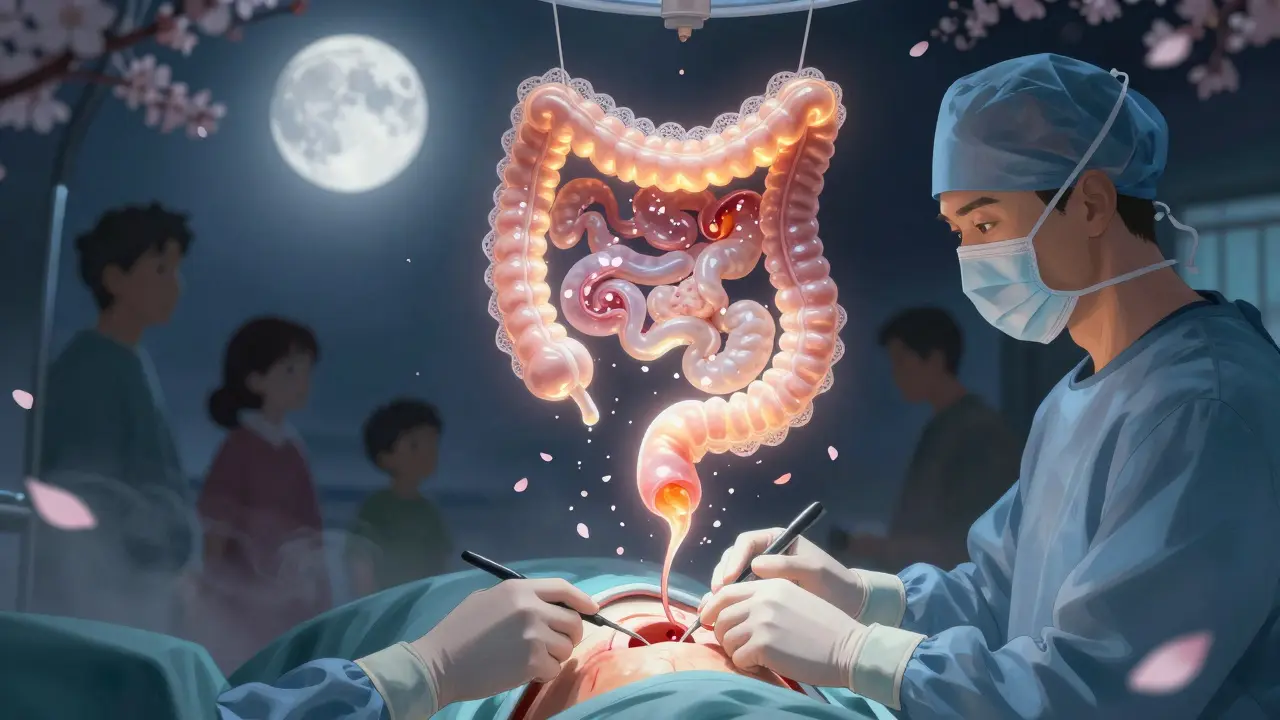
When Medical Treatment Isn’t Enough
For people with severe Crohn’s disease or ulcerative colitis, medications can only do so much. Even the strongest biologics may stop working, or complications like bowel blockages, uncontrolled bleeding, or cancer risk force a different path. That’s when surgery becomes necessary. It’s not a failure-it’s a next step. About 75% of Crohn’s patients and up to 30% of those with ulcerative colitis will need surgery at some point. Many walk away from the operating room with a life that’s not just better, but truly livable again.
What Does Bowel Resection Actually Mean?
Resection means cutting out the damaged part of the intestine and reconnecting the healthy ends. In Crohn’s disease, this often happens in the lower right side of the abdomen, where the small intestine meets the colon. Surgeons remove the inflamed section-sometimes just a few inches, sometimes more-and stitch the good parts back together. This is called an ileocolic anastomosis. The goal? To remove the problem without taking out more than needed.
Unlike ulcerative colitis, which affects the entire colon uniformly, Crohn’s skips around. That’s why surgeons avoid removing large stretches of bowel unless absolutely necessary. Too much removal can lead to short bowel syndrome, where the body can’t absorb enough nutrients. A 2023 study from Cleveland Clinic found that 60-70% of Crohn’s patients stay in remission for five years after a single resection, but that number drops to about 20% by year ten without ongoing medication. That’s why surgery isn’t a cure-it’s a reset.
Why the J-Pouch Is a Game Changer for Ulcerative Colitis
If you have ulcerative colitis, your colon is the source of the problem. The only way to truly eliminate it is to remove the whole thing. That’s where the ileal pouch-anal anastomosis, or J-pouch, comes in. It’s not just a surgery-it’s a reconstruction. Surgeons take the last 8-10 centimeters of your small intestine, fold it into a J-shape, and attach it directly to your anus. This creates a new internal reservoir to hold stool, so you don’t need a permanent bag.
The procedure usually happens in two or three stages. First, the colon and rectum are removed, and a temporary ileostomy is created to let things heal. After 8-12 weeks, the pouch is built and connected. Then, after another few months, the stoma is closed. Most people end up with 4-8 bowel movements a day, and about 80-90% report high satisfaction. The biggest win? No more bloody stools. No more urgent bathroom runs. No more constant fear of accidents.
But it’s not perfect. About 40% of people develop pouchitis-an inflammation of the new pouch-sometimes repeatedly. Antibiotics help, but long-term management is often needed. And while most regain control, some still leak at night or need absorbent pads. It’s a trade-off, but for many, it’s worth it.
Ostomy: Living With a Stoma
Not everyone is a candidate for a J-pouch. If your anal sphincter is weak, if you’re over 70, or if you have Crohn’s disease affecting the area, a permanent ileostomy may be the safer, simpler choice. An ileostomy brings the end of your small intestine through your abdominal wall. Waste exits into a bag you wear outside your body.
The stoma itself is about the size of a quarter, sticking out 1-2 centimeters. You’ll empty it 4-6 times a day. It sounds intimidating, but most people adapt quickly. The bags today are thin, odor-proof, and stick securely-even during exercise or swimming. Many patients say the biggest relief isn’t the lack of pain-it’s the lack of anxiety. No more planning your day around bathrooms. No more hiding.
But there are challenges. Skin irritation from leakage is common, affecting nearly half of those who report negative experiences. That’s why working with a certified wound, ostomy, and continence nurse (WOCN) before and after surgery is critical. They teach you how to measure your stoma, choose the right barrier, and prevent infections. Products like the Convatec Adapt Mini Belt ($45.99) help keep the bag secure and reduce leaks. And while some struggle with body image, many find community online-Reddit’s r/IBD has over 28,000 members sharing tips, stories, and reassurance.

What Happens After Surgery?
Recovery doesn’t end when you leave the hospital. The first few weeks are about healing, but the next six to twelve months are about adjusting. Your body is learning to function differently.
If you have a J-pouch, expect frequent bowel movements at first-up to 10 a day. Over time, it settles to 4-8. Drinking 8-10 cups of fluid daily is non-negotiable. Dehydration is a top reason for hospital readmission in the first 90 days. Avoid high-fiber foods like raw vegetables, nuts, and popcorn early on. They can block the new connection. Your diet will slowly expand, but you’ll always need to be careful.
If you have a permanent stoma, you’ll need to monitor output. If you’re producing more than 1,500 milliliters in a day, or if you have a fever over 38.3°C (101°F), call your doctor. These could mean infection or blockage. Pain management is also tricky. IBD surgery patients have a 22% higher risk of becoming dependent on opioids than those who have other abdominal surgeries. Many now use non-opioid pain plans-nerve blocks, acetaminophen, and anti-inflammatories-to reduce this risk.
Minimally Invasive Techniques Are Now the Standard
Twenty years ago, IBD surgery meant a large incision down the belly. Today, most procedures are done laparoscopically-with tiny cameras and instruments through 3-5 small cuts. Some centers, like Mayo Clinic, are even using robotic systems. These methods cut hospital stays from 7-10 days to just 3-5. Recovery is faster, pain is less, and scarring is minimal.
Laparoscopic J-pouch surgery is now done in 65% of cases, up from just 25% in 2010. Robotic-assisted surgery is growing fast. Mayo’s 2022 data showed a 20% drop in operating time and 15% fewer complications with robotics. It’s not available everywhere yet, but it’s becoming more common in major centers.
Who Gets Which Surgery?
It’s not one-size-fits-all. Your age, sex, disease type, and even your fertility goals matter.
- Ulcerative colitis patients under 40 with strong anal muscles almost always get the J-pouch. It’s the gold standard.
- Patients over 65 or those with poor sphincter control often get a permanent ileostomy. Pouch surgery carries higher risks for them.
- Women should know: J-pouch surgery increases infertility risk from 15% to 50-70%. If you want children, talk to your surgeon about freezing eggs before surgery.
- Men face a 15-20% chance of new erectile dysfunction after J-pouch surgery. Nerve-sparing techniques help, but it’s still a real risk.
- Crohn’s patients rarely get J-pouches. The disease often comes back in the pouch. A resection or temporary stoma is safer.

What’s New in IBD Surgery?
The field is moving fast. In 2023, the FDA approved the first smart ostomy bag-OstoLert by ConvaTec. It has sensors that alert you via smartphone if it’s leaking or too full. That’s a game-changer for confidence and independence.
Researchers are also testing 3D-printed pouch designs tailored to your anatomy. Early trials at Cleveland Clinic show promise for better function and fewer leaks.
And then there’s microbiome therapy. The NIH is funding a $2.4 million study to see if transplanting healthy gut bacteria can prevent pouchitis. Early results show a 40% drop in inflammation after 12 months. That could change how we manage life after surgery.
Real People, Real Outcomes
A 2022 survey of nearly 2,000 IBD patients in the UK found:
- 85% of permanent ostomy patients were satisfied after five years.
- 78% of J-pouch patients were satisfied-but 22% needed more surgery for complications.
- 68% of J-pouch patients were readmitted within 90 days, mostly for dehydration or pouchitis.
- Only 42% of permanent stoma patients had the same issue.
On forums like the Crohn’s & Colitis Foundation’s IBD Help Center, 78% of J-pouch patients said their quality of life improved dramatically. Common phrases: “I can go on a road trip without panic.” “I slept through the night for the first time in 10 years.”
But the honest voices are the ones who say: “It’s not magic. You’ll still have bad days. You’ll still need to plan. But you’re free.”
What to Do Next
If you’re considering surgery:
- Find a surgeon who specializes in IBD-not just general colorectal. Centers with dedicated IBD teams have 35% fewer complications.
- Ask for a referral to a WOCN before your first consult. They’ll show you what to expect.
- Discuss fertility, sexual health, and long-term risks upfront. Don’t wait until after surgery.
- Join a support group. Whether it’s online or in person, talking to others who’ve been there makes a huge difference.
- Plan for recovery time. Even with minimally invasive surgery, you’ll need 6-8 weeks before returning to normal activity.
Surgery isn’t the end of your journey with IBD. It’s the start of a new chapter-one where you have more control, more freedom, and more life to live.





Bob Cohen
February 1, 2026 AT 06:36Ishmael brown
February 2, 2026 AT 02:26Aditya Gupta
February 2, 2026 AT 11:31Nancy Nino
February 2, 2026 AT 17:06Deep Rank
February 3, 2026 AT 01:52Sami Sahil
February 3, 2026 AT 22:28franklin hillary
February 5, 2026 AT 13:08vivian papadatu
February 5, 2026 AT 14:26Melissa Melville
February 5, 2026 AT 19:40