Elderly Medication Risk Screener
Medication Analysis
Select medications from the list below to see their primary risks and manifestations in older adults.
Quick Tip: Polypharmacy
Taking 5 or more medications concurrently significantly increases the risk of adverse drug reactions (ADRs).
Click on a medication to analyze the potential risks.
This tool is for educational purposes and does not replace professional medical advice.Imagine a medication that works perfectly for a 40-year-old but causes a 70-year-old to experience sudden confusion or a dangerous fall. This isn't usually because the drug itself changed, but because the person did. As we age, our bodies process chemicals differently, making medication side effects in elderly patients a complex and often dangerous challenge. While medicines are vital for managing chronic conditions, the line between a therapeutic dose and a toxic one narrows significantly after age 65.
The core of the problem is that older adults are more than twice as likely to suffer from adverse drug reactions (ADRs) compared to younger people. In many cases, these reactions don't look like a typical rash or an upset stomach. Instead, they show up as "geriatric syndromes"-things like sudden memory loss, dizziness, or lethargy-which are often mistaken for "just getting old" when they are actually the result of a drug interaction or overdose.
Why the Body Reacts Differently With Age
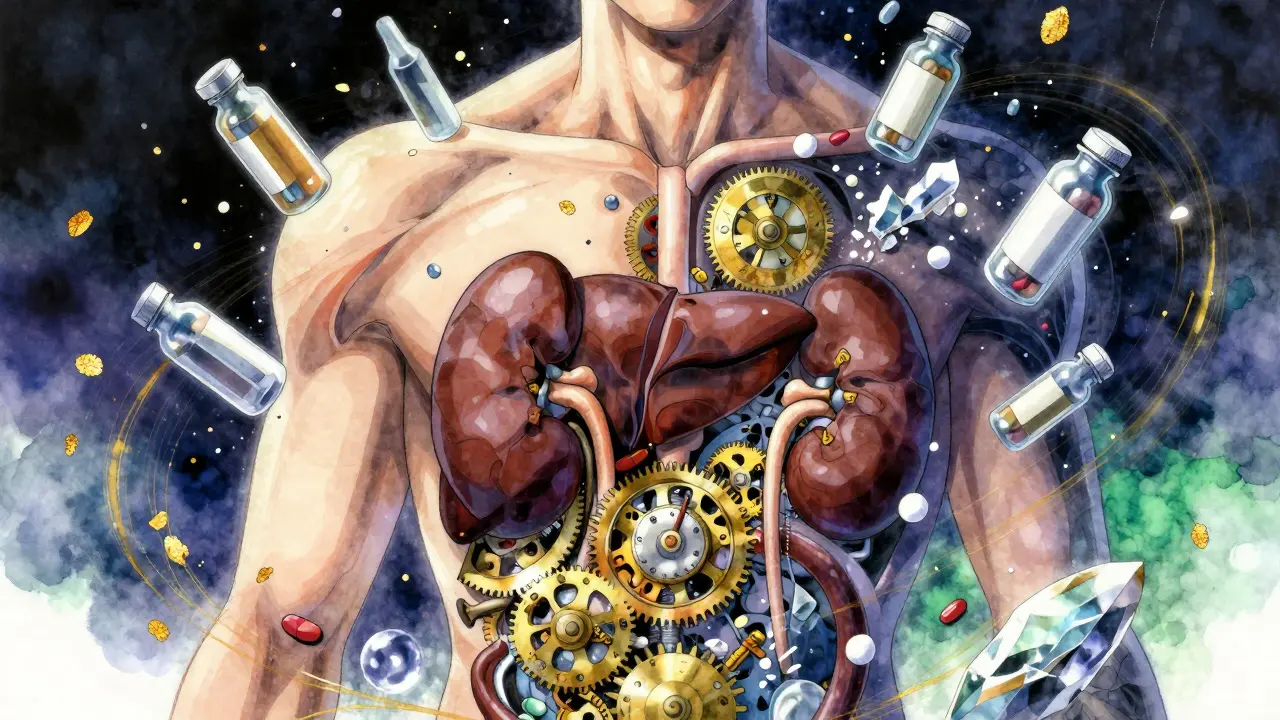
The way a drug moves through the body is called pharmacokinetics. In older adults, several physiological shifts change how drugs are absorbed, distributed, and cleared. These aren't just minor changes; they are fundamental shifts in biological machinery.
First, the liver-the body's primary filtration system-slows down. Hepatic blood flow can drop by as much as 30-40% between the ages of 25 and 75. When the liver can't process a drug quickly, that medication stays in the bloodstream longer, effectively increasing the dose over time.
Second, the kidneys lose efficiency. The glomerular filtration rate, which measures how well the kidneys clean the blood, typically declines by about 0.8 mL/min per year after age 40. If a drug is cleared through the kidneys and the filtration is slow, the drug accumulates, leading to toxicity.
Third, the body's composition shifts. Older adults tend to have a higher percentage of body fat and less lean muscle mass. For instance, body fat may rise from 25% at age 30 to nearly 40% by age 70. This is critical because fat-soluble drugs store themselves in these adipose tissues, extending their "half-life." A classic example is seen with benzodiazepines like Diazepam; while it might last 24-48 hours in a young adult, it can linger for several days in an elderly patient, causing prolonged sedation and a high risk of falls.
The Danger of Polypharmacy and Multimorbidity
It is rare for a patient over 75 to take only one medication. This is where Polypharmacy-the concurrent use of five or more medications-becomes a major risk factor. When you add Multimorbidity (having multiple chronic conditions) into the mix, the risk of drug-drug interactions skyrockets.
One of the most dangerous combinations involves NSAIDs (like ibuprofen or indomethacin) and other medications. If a patient takes oral anticoagulants alongside NSAIDs, the risk of hemorrhagic peptic ulcer disease increases dramatically. Similarly, combining corticosteroids with NSAIDs can increase the risk of peptic ulcers by 15-fold compared to those not using these drugs.
There is also the issue of the Cytochrome P-450 enzyme system in the liver. Many drugs compete for the same enzyme to be metabolized. If two drugs fight for the same enzyme, one may not be broken down, leading to toxic levels in the blood, while the other may be processed too quickly, rendering it ineffective.
Identifying High-Risk Medications
Not all drugs are created equal when it comes to senior safety. Healthcare providers often rely on the Beers Criteria, a widely accepted list of medications that are potentially inappropriate for older adults. These guidelines help doctors spot drugs where the risks likely outweigh the benefits.
| Medication Type/Name | Primary Risk for Elderly | Specific Manifestation |
|---|---|---|
| Pentazocine | CNS Sensitivity | Confusion and hallucinations |
| Indomethacin | CNS Toxicity | High rate of mental status changes among NSAIDs |
| SSRIs | Fall Risk | Increased risk of fractures and balance issues |
| Glyburide | Hypoglycemia | Severe drops in blood sugar due to slow clearance |
| Phenylbutazone | Hematological | Serious blood-related complications |
Beyond the specific drugs, certain classes require extreme caution. For example, acetylcholinesterase inhibitors can trigger bradycardia (slow heart rate) in patients who suffer from syncope (fainting), and "glitazones" used for diabetes are often contraindicated in patients with heart failure due to fluid retention risks.
How to Spot a Side Effect (The "Silent" Symptoms)
In younger patients, a side effect is often obvious: a rash, nausea, or a headache. In the elderly, side effects are often "silent" or non-specific. This is why 20-30% of falls in older adults are actually caused by medication side effects rather than balance issues or muscle weakness.
Watch for these subtle red flags:
- Cognitive Shifts: Sudden confusion, disorientation, or "brain fog" that mimics dementia.
- Physical Instability: Dizziness, unsteady gait, or a sudden increase in the frequency of falls.
- Weight Fluctuations: Unexplained weight gain (often due to fluid retention from heart medications) or weight loss (due to appetite suppressants).
- Sleep Changes: Excessive daytime sleepiness or paradoxical insomnia.

Strategies for Safer Medication Management
The goal isn't to stop all medications-vaccines, antibiotics, and antihypertensives are life-saving. The goal is "optimization." This involves a process called deprescribing: the planned and supervised reduction or cessation of a medication that may no longer be beneficial or may be causing harm.
To manage this safely, a multidimensional approach is necessary. It starts with a complete medication list. This shouldn't just be prescription drugs; it must include over-the-counter (OTC) meds, vitamins, herbal supplements, and minerals. A simple a-vitamin supplement might seem harmless, but it can interfere with blood thinners.
Interdisciplinary collaboration is the gold standard. A physician manages the diagnosis, but a pharmacist is often the best person to spot a P-450 interaction or a Beers Criteria violation. Nurses and caregivers are the "eyes and ears" who notice that a patient has become suddenly confused three days after starting a new diuretic.
For those managing care for a loved one, the best strategy is to ask specific questions during doctor visits. Instead of asking "Is this medicine safe?", ask "How does this drug affect balance or memory in people over 80?" or "Could this medication be causing the dizziness we've seen lately?"
Why are elderly patients more sensitive to drugs?
Sensitivity is caused by physiological changes: reduced liver blood flow (meaning slower drug metabolism), a lower glomerular filtration rate in the kidneys (leading to slower drug excretion), and an increase in body fat percentage, which causes fat-soluble drugs to linger longer in the system.
What is the Beers Criteria?
The Beers Criteria is a clinically recognized list of medications that are generally considered potentially inappropriate for older adults. It identifies drugs where the risk of adverse effects usually outweighs the clinical benefit, helping providers avoid medications that increase the risk of falls, confusion, or organ failure.
Can polypharmacy be avoided entirely?
Not always, as many seniors have multiple chronic conditions (multimorbidity) that require different treatments. However, it can be managed through "deprescribing," where doctors regularly review all medications to remove those that are no longer necessary or are causing harmful interactions.
What are the most common signs of a drug reaction in seniors?
Unlike younger people, seniors often show non-specific symptoms. The most common are sudden confusion, dizziness, increased falls, changes in memory, and unexpected weight gain or loss. These are often misattributed to aging rather than the medication.
Are over-the-counter (OTC) medications safe for the elderly?
Not necessarily. Many OTC drugs, such as NSAIDs (ibuprofen) or certain sleep aids, can cause serious gastrointestinal bleeding or cognitive impairment in older adults. All OTC products, including vitamins and herbal supplements, should be disclosed to a healthcare provider to check for interactions.
Next Steps for Patients and Caregivers
If you are caring for an older adult or are managing your own medications, start by creating a "Master Medication List." Include the dose, the time of day it's taken, and what the doctor says it's for. If you notice a new symptom-like a stumble or a bout of forgetfulness-don't assume it's just age. Check if it coincides with a new prescription or a change in dosage.
For those with cognitive or physical impairments, consider using automatic pill dispensers or hiring a medication management service to prevent errors. Finally, schedule a "Medication Review" appointment specifically to go over the list, rather than trying to squeeze it into a standard 15-minute check-up. This dedicated time allows the provider to apply tools like the Beers Criteria and STOPP/START guidelines to ensure the regimen is safe.



Carol Yang
April 27, 2026 AT 17:34Super helpful stuff!
Sharyl Foster
April 28, 2026 AT 20:21Everyone always talks about the Beers Criteria like it's the holy grail, but honestly, some of those "inappropriate" drugs are the only things that actually work for certain patients. It's kind of a joke that we just follow a list instead of looking at the individual, but whatever.
Edwin Perez
April 29, 2026 AT 21:12Funny how they focus on the liver and kidneys but don't mention how big pharma pushes these meds just to get seniors hooked on a cocktail of drugs that keep them dependent on the system. They want you confused and dizzy so you can't think for yourself. It is all a racket to keep the profits soaring while the elderly just fade away in nursing homes.
Brittney Prince
May 1, 2026 AT 14:06Exactly. They just keep adding more pills to fix the side effects of the first pill. It's a literal death spiral and nobody is talking about how some of these trials are just skewed to hide the real numbers of ADRs in the 70+ crowd.
Elle Torres Sanz
May 2, 2026 AT 15:29I think we should try to look at this with a bit more empathy for the doctors too, because they are often rushed in those 15-minute appointments. It's a systemic issue where we need more pharmacists integrated into primary care to help catch these things before they become crises. Maybe we can find a way to advocate for longer geriatric visits together.
Vijay AGarwal
May 3, 2026 AT 21:17OH MY GOD, the part about benzodiazepines is absolutely terrifying! I have seen families completely devastated because a grandmother took a simple sleep aid and ended up with a hip fracture that changed her life forever! It is an absolute tragedy that this isn't common knowledge! We are talking about lives here, not just pharmacy textbooks! The horror of a "silent symptom" is just too much to bear!
Jaclyn Vo
May 4, 2026 AT 00:09Ugh, finally someone mentions the dizziness! 🙄 I've told my doctor a thousand times that my meds make me feel like I'm on a boat and he just shrugs it off. It's literally in the guidelines! Like, do I have to be a pharmacist to get a decent prescription? 💅✨
James Harrison
May 5, 2026 AT 21:58It's interesting to think about how our biological decline mirrors a loss of control. We spend our youth building this machine and then spend our old age trying to manage its breakdown with external chemicals. There's a certain poetry to the fragility of it all, if you think about it deeply enough.
Michael Deane
May 6, 2026 AT 03:35This is exactly why we need to get our own healthcare system sorted out and stop relying on these generic global guidelines that don't account for the ruggedness of the American spirit or the specific needs of our veterans who have served this country and deserve the absolute best care without being treated like lab rats in a system that's failing every single person who actually worked hard for their living!
Beena Garud
May 7, 2026 AT 02:47One must consider the ethical implications of deprescribing. While the pharmacological benefit is clear, the psychological impact of removing a medication that a patient believes is sustaining them can be profound. We must balance the clinical necessity of reducing toxicity with the existential need for the patient to feel cared for and stabilized in their final chapters of life.
sachin singh
May 8, 2026 AT 03:49I find the mention of the Cytochrome P-450 enzyme system quite fascinating. It would be beneficial to understand if there are specific nutritional interventions or supplements that could support liver function in the elderly to mitigate some of these risks, provided they do not cause further interactions. The synergy between pharmacology and nutrition in geriatric care is a field that deserves more attention.