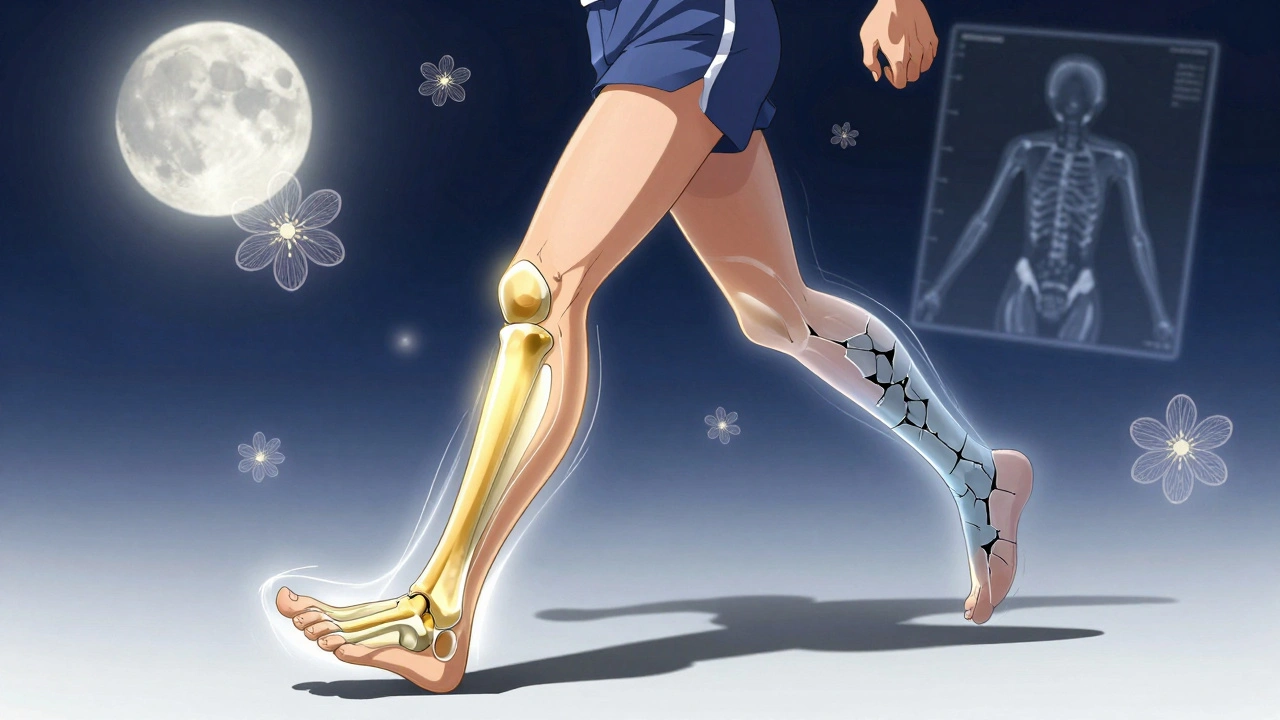
Running hurts-not the good kind of hurt, but the sharp, persistent ache along your shin that won’t go away no matter how much you stretch. You’ve been told it’s just shin splints, but what if it’s worse? What if it’s a stress fracture? The difference matters. One might need a week off. The other could need two months-and if you get it wrong, you’re not just delaying your run, you’re risking a full break.
Shin Splints vs. Stress Fractures: What’s the Real Difference?
Shin splints, or medial tibial stress syndrome (MTSS), are a broad inflammation of the muscles, tendons, and bone tissue around your tibia. You feel it as a diffuse, dull ache along the inner edge of your shinbone. It often shows up after increasing mileage too fast, running on hard surfaces, or wearing worn-out shoes. Pain usually eases during warm-up but comes back after you stop.
Stress fractures, or bone stress injuries (BSIs), are tiny cracks in the bone itself. The pain is sharper, more localized, and gets worse with activity. Press on the spot-it hurts. Walk on it? It throbs. You might even feel it at night. Stress fractures aren’t just ‘bad shin splints’-they’re bone damage. And bone doesn’t heal the same way muscle does.
Here’s the key: 13.6% to 20% of all running injuries are shin splints. Stress fractures? They make up 2% to 16%, but they’re far more dangerous. Women are at higher risk-up to 21% of female runners get them, compared to 8% of men. Why? Often, it’s not just training. It’s energy. Low calorie intake, missed periods, low iron-these aren’t side notes. They’re red flags. The International Olympic Committee now says: if you’ve had a stress fracture, you need to be screened for Relative Energy Deficiency in Sport (RED-S). It’s not optional.
Why the 10% Rule Doesn’t Work Anymore
You’ve heard it a thousand times: “Don’t increase your mileage by more than 10% per week.” It sounds smart. But it’s outdated. A 2024 review in Sports Medicine found that 68% of runners with stress fractures were following this rule-and still got injured. Why? Because bone doesn’t respond to percentages. It responds to load, recovery, and nutrition.
Bone remodeling takes 90 to 120 days. That’s the cycle: break down, rebuild, strengthen. If you keep adding miles every week, you’re asking your bones to keep up with a sprinter’s pace while they’re still recovering from last week’s marathon. You’re not being smart-you’re being impatient.
Instead of a fixed rule, use a pain-guided approach. If your shin hurts during or after running, stop. Not tomorrow. Not after the weekend. Now. Pain above a 2 out of 10 during activity? You’re pushing too hard. Pain that lingers for hours? You’ve crossed the line.

The 6-Phase Return-to-Run Protocol (Backed by Science)
There’s no magic number of days. Recovery isn’t a countdown. It’s a checklist. Here’s what works, based on clinical studies and real-world success rates from physical therapy clinics and elite athletic programs.
Phase 1: Stop. Rest. Assess.
For both shin splints and stress fractures, the first step is the same: stop running. But the length differs.
- Shin splints: 3 to 10 days of no running. You can walk, but if walking hurts, you need more rest.
- Stress fractures: 4 to 6 weeks of non-weight-bearing activity. That means no running, no jumping, no long walks. Use crutches if needed. This isn’t optional. A 2022 meta-analysis showed 32% of runners who rushed back re-injured themselves within 12 weeks.
During this phase, get an MRI. X-rays won’t show early stress fractures. An MRI will. And if you’re a woman with recurring injuries? Get a DXA scan for bone density. One in four runners with stress fractures have low bone mineral density. That’s not bad luck. That’s a medical issue.
Phase 2: Rebuild Strength-No Running Yet
When you can walk pain-free for 7 straight days, it’s time to rebuild. This isn’t about cardio. It’s about bone and muscle resilience.
- Double-leg heel raises: 3 sets of 15-20 reps, twice daily. Stand on a step if you can. Let your heels drop below the step for full range.
- Single-leg balance: 2 minutes per leg, eyes closed if you can. This improves proprioception-your body’s sense of where your foot is in space.
- Glute bridges and clamshells: 3 sets of 15 reps each. Weak glutes? That’s one of the top reasons runners re-injure. A Reddit thread of 142 runners showed 57% who skipped glute work were back in pain within 3 months.
Do these daily. No exceptions. This isn’t optional warm-up. It’s the foundation.
Phase 3: Load the Bone-Slowly
This is where most people fail. They think if they’re not in pain, they’re ready. But bone needs progressive, controlled stress to heal.
Start with step-ups: 3 sets of 10-15 reps, using a 6-inch step. Go slow. Control the descent. Add weight only when it feels easy.
Then, add low-impact cross-training: pool running, cycling, or using an AlterG anti-gravity treadmill. These let you simulate running without the impact. Studies show AlterG use cuts recovery time by 27 days on average.
Phase 4: Return to Running-The Run-Walk Method
Now, you’re ready to run. But not like before.
Here’s the exact protocol for low-risk stress fractures (posterior medial tibia):
- Week 1-2: 1 minute running, 4 minutes walking. Total: 20 minutes. Do this 3 times a week.
- Week 3: 1 minute running, 3 minutes walking. Total: 25 minutes.
- Week 4: 1 minute running, 2 minutes walking. Total: 30 minutes.
- Week 5: 1:1 ratio. Total: 35 minutes.
- Week 6: 3 minutes running, 1 minute walking. Total: 40 minutes.
High-risk sites-like the front of the tibia or the navicular bone-need 8 to 12 weeks. No shortcuts. If you feel pain above a 2/10 at any point, go back one step. Wait 3 days. Try again.
Phase 5: Build Back Volume
Once you’re running 40 minutes without pain, you can start increasing weekly mileage-but not by 10%. Increase by 5% every 10 days. And always take at least one full rest day between running days. Protocols with mandatory rest days cut recurrence by 34%.
Also, get your gait analyzed. A 2022 study found traditional heel lifts only reduce tibial strain by 12-15%. Gait retraining-learning to land softer, with a midfoot strike-cuts strain by 38%. That’s the difference between healing and re-injury.
Phase 6: Maintenance and Prevention
You’re back. Great. Now, don’t go back to old habits.
- Continue heel raises and glute work 2-3 times a week.
- Get your vitamin D and iron checked annually if you’re a female runner.
- Replace shoes every 300-500 miles. No exceptions.
- Use a wearable like the WHOOP strap-it detects abnormal bone loading patterns with 89% accuracy.
And if you’re serious? Get a yearly bone density scan. The American College of Sports Medicine now recommends this for all athletes with a history of stress fractures.
What If You Don’t Have a Physical Therapist?
Only 28% of rural U.S. counties have a physical therapist who specializes in running injuries. That’s a problem. But you’re not out of options.
Apps like Kinetic Sports Medicine and RunRx now offer protocol-guided rehab plans with video demos, progress trackers, and pain logs. Over 147,000 runners use them. They’re not perfect-but they’re better than guessing.
Also, check your insurance. In 2024, 87% of U.S. commercial plans cover up to 12 physical therapy sessions for stress fractures. That’s up from 63% in 2021. Call your provider. You’re covered.

Why Most People Fail
Here’s the hard truth: 42% of recreational runners quit or rush the protocol. Why?
- They think pain-free means healed. It doesn’t. Bone takes months to fully remodel.
- They skip glute work. Weak hips = bad mechanics = more stress on shins.
- They ignore nutrition. No fuel, no healing.
- They don’t track pain. No log = no accountability.
One Reddit user wrote: “I jumped to 1:1 after two pain-free days. Three weeks later, I was back in a boot.” That’s not bad luck. That’s a preventable mistake.
Success stories? Military recruits following the 6-week protocol had a 92% return rate. Strava data shows athletes who followed PT-guided plans got back to full mileage 22 days faster than those who didn’t.
The Future: AI, Blood Tests, and Personalized Recovery
This isn’t static. Science is moving fast.
In 2024, researchers validated a blood test that measures PINP and CTX-markers of bone formation and breakdown. These tell you exactly when your bone is ready to load. No more guessing. No more MRIs every month.
AI apps like RunRx are now predicting recovery timelines with 86% accuracy by analyzing your training history, biomechanics, and now, your blood work.
Vibration therapy is showing up in labs too. One 2024 study found it boosted bone density recovery by 22% in stress fracture patients.
But the biggest shift? The mindset. We’re moving from “rest until pain stops” to “heal the whole system.” Nutrition. Hormones. Sleep. Strength. Gait. Recovery isn’t just about your shins. It’s about your whole body.





Brooke Evers
December 7, 2025 AT 07:32I’ve been dealing with shin pain for over a year now, and this post literally saved my running career. I thought I just needed to ‘push through’-until I started getting pain at night. I ignored it for months because I didn’t want to admit I was injured. Getting an MRI was the best decision I ever made. Turns out, it was a stress fracture on the posterior medial tibia. I followed the 6-phase protocol exactly-no shortcuts. Took me 14 weeks to get back to full mileage, but I didn’t re-injure. Now I do heel raises every morning like clockwork. I even track my vitamin D levels. This isn’t just about running-it’s about listening to your body before it screams.
Also, replacing shoes every 400 miles? Game changer. I used to wait until they looked destroyed. Big mistake.
Thank you for writing this. I wish I’d found it sooner.
- Still running, still healing.
Saketh Sai Rachapudi
December 7, 2025 AT 09:26INDIA IS NOT USA! You people think every runner is white girl with WHOOP strap and AlterG treadmill? In India, we run on roads with potholes, no physio, no MRI, no insurance. We run with broken shoes and painkillers. Your 6-phase plan? Useless here. We don’t have time to wait 6 weeks. We run because we have no choice. Stop talking like you own the human body. You don’t.
Also, ‘glute bridges’? My uncle in Bihar does 100 squats before breakfast. He never had shin pain. Maybe you need less science and more dirt under your nails.
And why are all your examples women? Is running only for girls now?
joanne humphreys
December 8, 2025 AT 15:44This is one of the most thoughtful, well-researched pieces I’ve read on running injuries in a long time. I especially appreciated the emphasis on RED-S and the fact that bone healing isn’t linear. I’ve seen too many runners get frustrated because they’re told ‘it’s just shin splints’ and then end up in a cast six weeks later. The pain-guided approach makes so much sense-it’s intuitive, but we’ve been trained to ignore discomfort until it’s unbearable.
I also love that you mentioned gait retraining over heel lifts. I tried the heel lift for months and it barely helped. When I finally did a gait analysis, I realized I was overstriding like a robot. Adjusting my cadence dropped my tibial strain by half. It’s not glamorous, but it works.
Thank you for including the practical resources too-apps like RunRx and insurance info? That’s the stuff that actually helps people access care.
Just… please don’t stop writing like this.
Nigel ntini
December 9, 2025 AT 13:39Brilliant breakdown. This is exactly the kind of evidence-based, compassionate guidance that’s missing from most running forums. I’ve coached runners for 15 years, and the number of people who think ‘no pain, no gain’ applies to bones is staggering. You’re right-bone remodeling takes 90–120 days. You can’t rush biology.
The 1:1 run-walk progression is gold. I’ve had clients try to skip ahead, and every single time, they’re back in rehab within 6 weeks. The patience required here is the opposite of what our culture rewards.
Also, the mention of vitamin D and iron in female runners? Spot on. I had a client who had three stress fractures in two years. Turned out her ferritin was 8. She was eating ‘clean’ and thought she was healthy. She wasn’t. Nutrition isn’t a side note. It’s the foundation.
Thank you for writing this. Please write more.
Ashish Vazirani
December 10, 2025 AT 18:04Mansi Bansal
December 10, 2025 AT 23:40It is with the utmost gravity that I address this publication, which, while ostensibly well-intentioned, exhibits a profound epistemological bias toward Western biomedical paradigms, thereby rendering it culturally inapplicable to the majority of global runners who operate under resource-constrained conditions. The implicit assumption that access to MRI, AlterG treadmills, and wearable biometrics constitutes a universal standard of care is not merely naive-it is ethically indefensible.
Furthermore, the disproportionate focus on female runners’ nutritional status, while clinically valid, risks pathologizing normal physiological variation in athletic populations, particularly in cultures where menstrual irregularity is not stigmatized as a medical anomaly. The framing of RED-S as a universal diagnostic imperative may inadvertently reinforce patriarchal norms of bodily regulation under the guise of scientific objectivity.
One must also question the commercial underpinnings of the cited apps-RunRx and Kinetic Sports Medicine-whose data monetization practices remain opaque. Are we, as runners, becoming data points in a corporate wellness ecosystem? The ethical implications warrant further peer-reviewed scrutiny.
Thus, while the technical details are commendable, the underlying ideology demands critical deconstruction. I recommend the reader consult the works of Dr. A. N. Srinivasan on decolonizing sports medicine before implementing this protocol.
pallavi khushwani
December 12, 2025 AT 08:30I just wanted to say… I read this and cried. Not because I’m sad. But because I finally felt seen. I’ve been running since I was 12. I’m 32 now. I’ve had three stress fractures. Each time, I felt like I failed. Like I wasn’t strong enough. Like I was lazy for needing rest.
This post didn’t tell me to push harder. It told me to listen. To eat. To sleep. To do the boring stuff. The heel raises. The balance drills. The shoe replacements. The blood tests.
I used to think healing was about speed. Now I know it’s about patience. And kindness. To yourself.
Thank you. Not just for the science. For the humanity.
Dan Cole
December 13, 2025 AT 00:53Let’s be real: this entire post is just glorified corporate physio propaganda wrapped in a bow of peer-reviewed citations. You want to know why runners keep getting injured? Because they’re told to ‘listen to their bodies’ while their coaches scream ‘just run through it.’ The system is broken. Not the runner.
And yet here you are, offering a 6-phase protocol like it’s a divine revelation. Where were you when I was 19 and running 80 miles a week with a ferritin of 12? You think a WHOOP strap fixes systemic neglect? A blood test doesn’t pay your rent. A DXA scan doesn’t stop your sponsor from dropping you because you missed a race.
The real injury isn’t the stress fracture. It’s the belief that if you just follow the right protocol, you’ll be ‘fixed.’ You won’t. You’ll just be another statistic in a $3 billion running industry that profits from your pain and your guilt.
Stop selling recovery as a product. Start demanding systemic change. Or keep writing your 15-sentence paragraphs and pretending you’re helping.
I’m not mad. I’m just… done.
Billy Schimmel
December 14, 2025 AT 15:39So you’re telling me I should stop running… because my shin hurts? Wow. What a shocker. I’ve been doing this since 2015. I’ve run through sprains, plantar fasciitis, and a torn meniscus. You think I don’t know pain? I’m not gonna sit around for six weeks because my shin twinges. I’ll just take ibuprofen and keep going. You’re not a coach-you’re a babysitter with a clipboard.
Also, ‘replace shoes every 300 miles’? I’ve got a pair that’s been with me since 2018. They’re worn out, sure. But they feel like home. You can’t replace a home.
Anyway. I’m running tomorrow. And I’ll be fine. Probably.
Shayne Smith
December 16, 2025 AT 01:43My friend just got diagnosed with a stress fracture. She’s been crying every night. I showed her this post. She said, ‘I feel like someone finally got it.’ I don’t run, but I cried reading this too. Not because I’m emotional-I’m just… impressed. Like, wow. This is what care looks like.
Also, the part about glute bridges? I started doing them with my mom. She’s 67. Now she says she walks without her cane. So… yeah. This isn’t just for runners. It’s for humans.
Max Manoles
December 16, 2025 AT 20:49As someone who’s been through three stress fractures and two rounds of physical therapy, I can confirm: this protocol works. Not because it’s fancy. Because it’s consistent.
What nobody talks about is the mental toll. You think the pain is the hardest part? It’s not. It’s the guilt. The FOMO. The fear that you’ll never run the same way again.
I followed every step. Even the boring ones. Even the ones that felt pointless. The heel raises? I did them while watching Netflix. The balance drills? I did them while brushing my teeth.
It took 16 weeks to get back to 10K. I didn’t break any records. But I ran my first marathon last month. Pain-free.
This isn’t about speed. It’s about sustainability.
And if you’re reading this and thinking ‘I don’t have time’-you’re wrong. You have time. You just have to choose what matters.
Brooke Evers
December 17, 2025 AT 16:31Just wanted to reply to @MaxManoles-your comment made me tear up. I did the same thing. Did heel raises while waiting for my coffee. Balance drills while brushing my teeth. I even set a daily alarm: ‘Do the boring stuff.’ It’s not sexy. But it’s everything.
And I’m glad you ran that marathon. I’m running one next month. For the first time since 2021.
Thank you for saying that. I needed to hear it.