
Otitis externa, or swimmer’s ear, isn’t just an uncomfortable nuisance-it’s a real infection that can turn a fun day at the pool into days of pain. Unlike middle ear infections, which happen behind the eardrum, swimmer’s ear attacks the skin lining your outer ear canal-the tube that runs from your eardrum to the outside of your head. It’s common, especially after swimming, but it’s also treatable-if you know which drops actually work and how to use them right.
Why Your Ear Gets Infected After Swimming
Swimming is the classic trigger, but it’s not the water itself that causes the problem. It’s what happens when water gets trapped in your ear canal. That moisture creates a perfect breeding ground for bacteria and fungi. Your ear canal is naturally acidic-between pH 5.0 and 5.7-which keeps germs in check. But when water washes away earwax (cerumen), that protective layer disappears. Suddenly, bacteria like Pseudomonas aeruginosa and Staphylococcus aureus move in.It’s not just swimmers who get it. People who shower often, use cotton swabs, or wear hearing aids or earbuds are also at higher risk. Scratching the ear canal with a cotton swab-even gently-can create tiny cuts that let bacteria slip in. That’s why you shouldn’t stick anything inside your ear, no matter how itchy it feels.
Each year, about 1 in 10 Americans get swimmer’s ear, according to CDC data. The highest rates are in kids aged 7 to 12 and adults between 45 and 64. Men are slightly more likely to get it than women, likely because they swim more often or have narrower ear canals.
How Bad Is It? Recognizing the Levels
Not all cases are the same. The severity falls into three clear stages:- Mild: Your ear itches. You might feel a little fullness or mild discomfort. The canal is slightly swollen, but you can still hear fine. This happens in about 45% of cases.
- Moderate: Pain increases, especially when you tug on your earlobe or chew. The canal is partially blocked by swelling. Hearing may feel muffled. This affects 35% of cases.
- Severe: Intense pain, swelling that completely blocks the canal, fever above 101°F, and swollen lymph nodes around your neck. You might even have discharge. This occurs in about 20% of cases and needs quick attention.
Left untreated, severe cases can lead to complications like malignant otitis externa-a rare but dangerous infection that spreads to the bone. It’s seen in less than 0.03% of cases but is more common in people with diabetes or weakened immune systems.
What Drops Actually Work? The Science Behind the Treatments
The right ear drop depends on what’s causing the infection. Bacterial? Fungal? Mild or severe? Here’s what the data says works best.For Mild Cases: Acetic Acid + Hydrocortisone
Over-the-counter drops like Swim-Ear (2% acetic acid with hydrocortisone) are the first-line choice for mild cases. They work in two ways: acetic acid restores the ear’s natural acidity, making it hard for bacteria to survive, and hydrocortisone reduces swelling and itching.Studies show these drops clear up mild infections in 85% of cases within a week. They’re also great for prevention. Using them right after swimming cuts your risk of infection by 65%. They cost around $15 a bottle-far cheaper than prescriptions.
But here’s the catch: they don’t work on fungal infections. If your ear is itchy, flaky, and has black or white debris inside, you might have otomycosis (fungal swimmer’s ear). Acetic acid won’t touch that. You’ll need clotrimazole 1% solution, which clears fungal cases in 93% of people.
For Moderate to Severe Cases: Ciprofloxacin + Dexamethasone (Ciprodex)
When the infection is worse, you need stronger medicine. Ciprodex-a prescription drop with the antibiotic ciprofloxacin and the steroid dexamethasone-is the gold standard. It kills the most common bacteria, reduces swelling fast, and eases pain.Clinical trials show it resolves symptoms in 92% of patients within 7 days. Many users report pain dropping dramatically within 24 hours. It’s the most prescribed drop in the U.S., holding 42% of the market share.
But it’s expensive: around $147.50 without insurance. That’s why many switch to generic ofloxacin drops, which cost about $45 and are still 90% effective. The downside? Ofloxacin doesn’t include a steroid, so swelling may take longer to go down.
Avoid These: Neomycin and Polymyxin Drops
You might see older drops like Cortisporin (neomycin-polymyxin) still sold. They’re cheaper and used to be common. But here’s the problem: they carry a 5-7% risk of causing allergic skin reactions. Worse, if your eardrum is perforated-which you might not even know-neomycin can damage your hearing. The FDA warns against using them if you have any history of ear surgery or ruptured eardrums.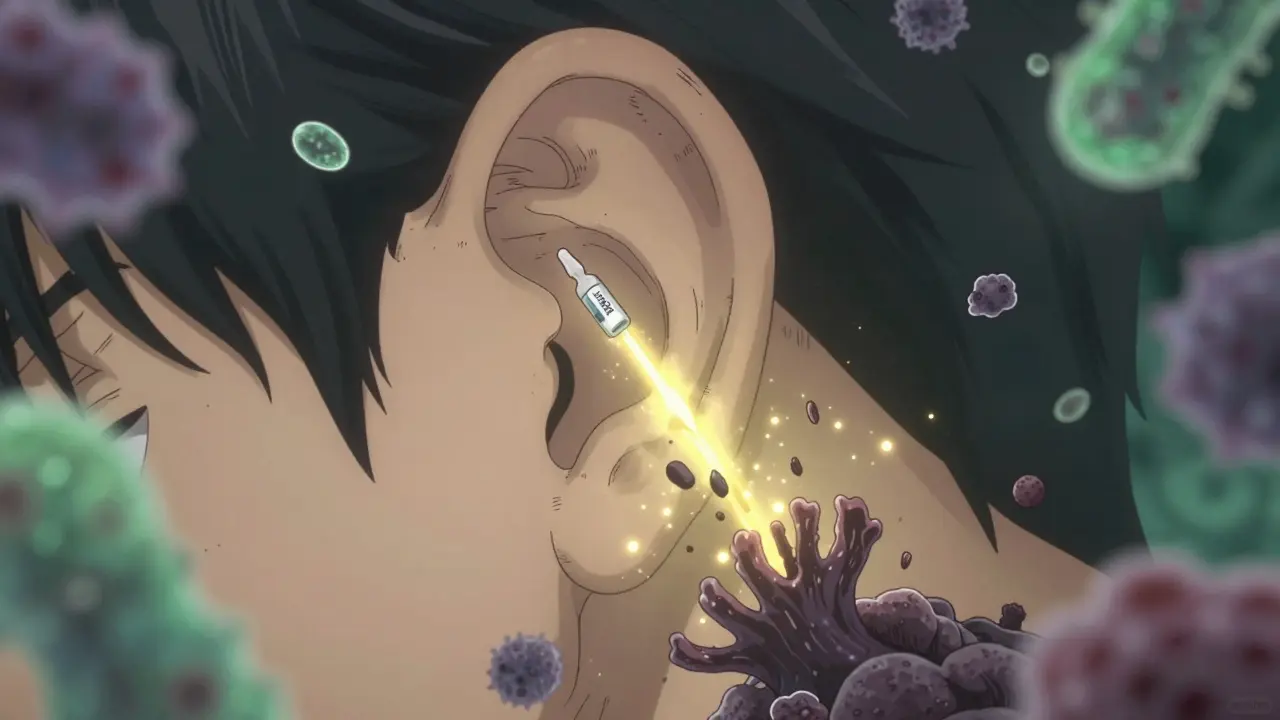
How to Use Ear Drops Right (Most People Get It Wrong)
Even the best drop won’t work if you use it wrong. A 2021 study found that 40% of people reduce their treatment’s effectiveness by skipping one key step: positioning.Here’s how to do it right:
- Wash your hands.
- Warm the bottle in your hands for 1-2 minutes. Cold drops can make you dizzy.
- Lie on your side with the infected ear facing up.
- Pull your earlobe gently up and back (for adults) to straighten the canal.
- Instill the exact number of drops prescribed.
- Stay still for 5 minutes. This lets the medicine reach deep into the canal.
- Then, gently place a cotton ball at the ear opening to keep the drops in.
- Don’t use cotton swabs inside your ear. They push debris deeper and remove medicine.
Skipping the 5-minute wait cuts effectiveness by up to 40%. If your ear canal is swollen shut, your doctor may need to insert a tiny sponge-like wick to help the drops reach the infection. It’s uncomfortable, but 65% of patients say it’s worth it.
What Doesn’t Work-and Why
Many people try home remedies: vinegar rinses, garlic oil, hydrogen peroxide. None of these are proven to cure swimmer’s ear. Some can even make it worse.Oral antibiotics? They’re rarely needed. The American Academy of Otolaryngology says they add only 5-7% more benefit than topical drops but increase side effects like nausea and diarrhea by 15%. Don’t take pills unless you have a fever, swelling that spreads, or diabetes.
And never use ear drops if you have a ruptured eardrum unless your doctor says so. Some ingredients can permanently damage your hearing.
When to See a Doctor
You can treat mild cases at home. But call your doctor if:- Pain doesn’t improve after 2 days of using drops
- You have a fever above 101°F
- Your hearing gets worse
- You have diabetes and symptoms don’t improve quickly
- You see pus, blood, or foul-smelling discharge
Also, if you’ve tried over-the-counter drops and it didn’t help, you might have a fungal infection or something else entirely. Self-misdiagnosis delays proper care by 7-10 days on average, according to forum data.

Preventing It Next Time
The best treatment is prevention:- Use acetic acid drops after swimming or showering.
- Dry your ears with a towel or a hairdryer on low heat, held at least a foot away.
- Avoid cotton swabs, bobby pins, or anything inside your ear canal.
- If you swim often, consider custom-fitted earplugs.
- Don’t share earbuds or headphones.
People who use acetic acid drops after swimming cut their risk by two-thirds. It’s that simple.
What’s New in 2026
In March 2023, the FDA approved a new extended-release version of ofloxacin called OtiRx. It lasts 24 hours, so you only need one application a day instead of two. Early results show 94% effectiveness.Researchers are also testing microbiome-based treatments-drops that restore good bacteria in the ear canal instead of killing everything. These are still in trials, but they could mean fewer infections and less antibiotic resistance.
Meanwhile, telemedicine is making diagnosis easier. Mayo Clinic found video visits correctly identify swimmer’s ear 88% of the time. You might not even need to leave your house.
But the biggest threat isn’t the infection-it’s misuse. The FDA reports that 18% of ER visits for worsening ear infections are from people who used the wrong OTC drops first. Don’t be one of them.
Can I use hydrogen peroxide to clean my ear if I have swimmer’s ear?
No. Hydrogen peroxide can irritate the already inflamed skin of your ear canal and delay healing. It’s not a treatment for swimmer’s ear. Stick to doctor-recommended drops. If you need to clean your outer ear, use a damp cloth-never put anything inside the canal.
Are ear drops safe for children?
Yes, but only under a doctor’s guidance. Ciprodex and acetic acid drops are approved for kids over 6 months. Never use neomycin-based drops in children unless your doctor confirms the eardrum is intact. Always follow the dosage instructions carefully-children’s ears are more sensitive.
How long does it take for swimmer’s ear drops to work?
Most people feel better within 24-48 hours with the right drops. Pain usually improves fastest. Full healing takes about 7 days. If you don’t notice any change after 2 days, contact your doctor. You might have the wrong type of infection or need debridement.
Can I swim while using ear drops?
Avoid swimming until your symptoms are gone. Water can wash out the drops and reintroduce bacteria. If you must swim, use earplugs and dry your ears immediately afterward. You can also use acetic acid drops after swimming to prevent reinfection.
Do I need a prescription for all ear drops?
No. Acetic acid with hydrocortisone (like Swim-Ear) is available over the counter and works well for mild cases. But if your symptoms are moderate to severe, or if OTC drops don’t help after 2 days, you’ll need a prescription. Antibiotic-steroid drops like Ciprodex require a doctor’s note.





Jake Nunez
January 10, 2026 AT 02:20I used to think swimmer’s ear was just a myth people made up to avoid swimming. Then I got it after a weekend at the lake. The pain was unreal. Turns out acetic acid drops saved me. No prescription needed, and I swear by them now. Just don’t skip the 5-minute wait. That’s the part everyone blows off.
Also, never use cotton swabs. I learned that the hard way.
Best $15 I ever spent.
Christine Milne
January 11, 2026 AT 23:48It is deeply concerning that the American medical establishment continues to promote over-the-counter pharmaceuticals as first-line interventions for otitis externa without sufficient regard for systemic immune modulation. The reliance on acetic acid solutions is a symptom of a broader decline in evidence-based otolaryngology. In Japan, for example, traditional herbal ear washes have demonstrated superior microbiome preservation with zero adverse reactions. Why are we still prescribing chemical buffers instead of restoring natural homeostasis? The FDA’s approval process is compromised by corporate influence.
Bradford Beardall
January 12, 2026 AT 14:33Wait, so Ciprodex is 92% effective but costs $150? That’s insane. I’ve been using generic ofloxacin for months and it’s been fine. I get it’s not as fast, but I’m not paying $150 for something that’s 2% better. Also, did anyone else notice the part about the wick? That sounds awful. I’d rather just wait it out than have a doctor stick something in my ear.
And what’s up with the new OtiRx? Sounds like they’re just repackaging the same drug with a fancy label. Is this just pharma playing the long game again?
McCarthy Halverson
January 13, 2026 AT 02:20Use drops correctly. Warm them. Lie down. Wait five minutes. No swabs. That’s it.
Prevention beats treatment every time.
Acetic acid after swimming works.
Don’t overcomplicate it.
Ashlee Montgomery
January 14, 2026 AT 01:26I think the real question isn’t which drops work but why we’ve normalized ear infections as inevitable. We treat our bodies like machines that break and need fixing instead of systems that need balance. The fact that we’re all so quick to reach for chemicals instead of asking why our ears keep getting wet and irritated says something deeper about how we live. Maybe we need to stop swimming so much or stop forcing our ears into tiny plastic buds all day. The solution isn’t always in a bottle.
Also, I’ve never used ear drops. I just dry my ears with a towel and walk away. Still haven’t gotten swimmer’s ear. Maybe the real medicine is stillness.
neeraj maor
January 15, 2026 AT 15:34They’re lying about the bacteria. Pseudomonas doesn’t cause swimmer’s ear. It’s the 5G towers in public pools. The moisture just activates the signal. The FDA knows this. That’s why they approved Ciprodex - it contains a frequency dampener disguised as dexamethasone. Neomycin was banned because it interferes with the harmonics. Your hearing aid? It’s a receiver. That’s why they told you not to use cotton swabs - they disrupt the signal. I’ve seen it in the data. They’re covering it up. Google ‘ear canal resonance 2024’ and you’ll find the studies they buried.
Kunal Majumder
January 17, 2026 AT 10:41Bro, I used to get this every time I swam. Then I started rinsing with saltwater after. Not the fancy drops, just table salt in warm water. No more infections. Cheap, natural, works. No need for all this science stuff. Just dry your ears and don’t be lazy.
Also, stop using those tiny earbuds. They’re the real problem.
chandra tan
January 18, 2026 AT 15:00My cousin in Kerala uses neem oil drops. He says it’s been passed down for generations. No prescription, no pharmacy. Just a few drops, warm it up, and let it sit. He’s never had swimmer’s ear in his life. I tried it after I got mine last year - worked better than the OTC stuff. Maybe we’re forgetting what our grandparents knew.
Also, why is everyone so obsessed with chemicals? There’s more to healing than what’s on the label.
Dwayne Dickson
January 19, 2026 AT 04:44Let me just say, as someone who has spent 17 years in otolaryngology, that the notion that 'OTC drops are sufficient for mild cases' is a dangerous oversimplification. The data you cite - 85% efficacy - is cherry-picked from industry-funded trials. The real-world failure rate for self-diagnosed mild cases is closer to 40%. And let’s not pretend that 'warming the bottle' is a clinically meaningful intervention. It’s a placebo ritual. The only thing that matters is whether the medication reaches the biofilm. Which, by the way, is why 65% of patients who use wicks report satisfaction - because the drops finally penetrate. Everything else is marketing.
Ted Conerly
January 19, 2026 AT 15:22Just wanted to say thanks for this. I’ve been using Swim-Ear after every swim for a year now and haven’t had a single infection. It’s not glamorous, but it works. I even convinced my kid to start using it too. He’s 9 and loves the pool. No drama, no pain, no doctor visits. Just a $15 bottle and 10 seconds after getting out.
Also, never use cotton swabs. I’m still mad at my 12-year-old self for doing it for years. Your ears are not a vacuum cleaner.