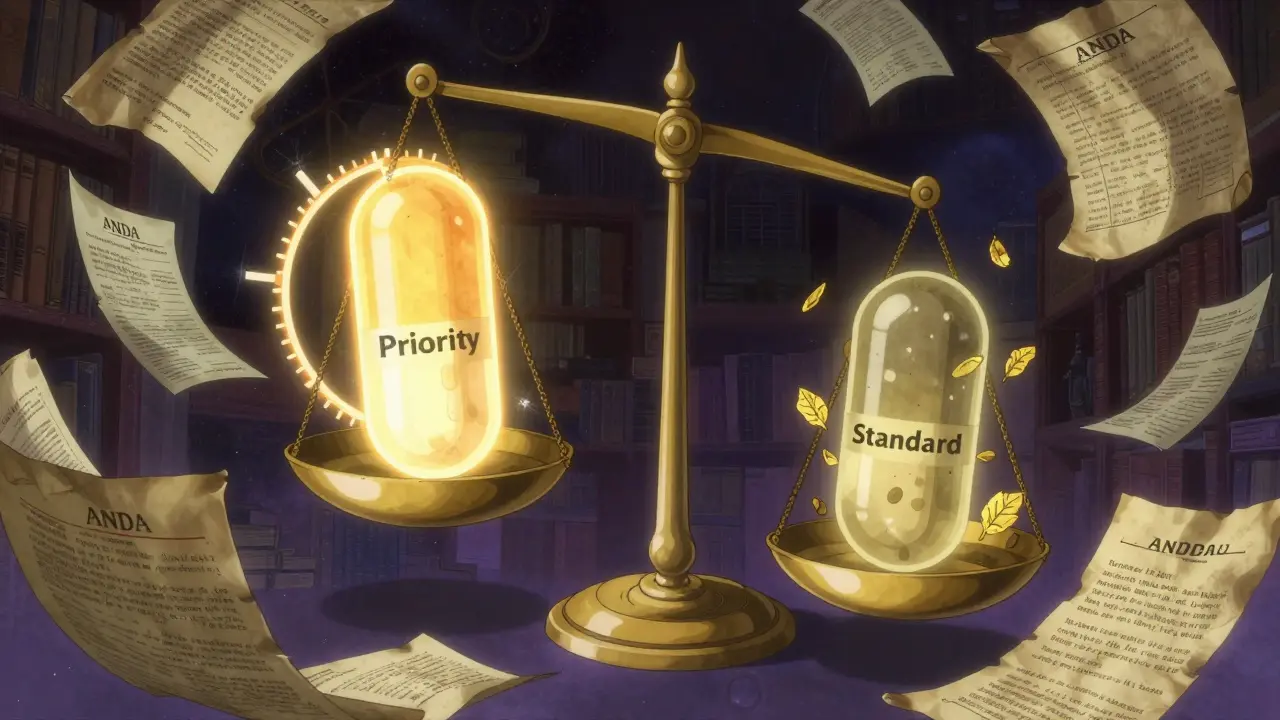
When a generic drug hits the market, it’s not just luck. Behind every affordable pill is a complex race - one where the U.S. Food and Drug Administration (FDA) holds the starting gun. Not all generic drug applications are treated the same. Some get a fast track. Others wait. The difference? Priority review versus standard review.
What’s the real difference between priority and standard review?
The FDA doesn’t just file and forget. It uses two clear timelines for reviewing generic drug applications, called Abbreviated New Drug Applications (ANDAs). Standard review takes 10 months. Priority review? Just 8 months. That two-month gap might sound small, but in the generic drug world, it’s worth hundreds of millions of dollars. This system didn’t come from nowhere. It’s built on the Generic Drug User Fee Amendments (GDUFA) III, which took effect in October 2022 and runs through 2027. These rules replaced older timelines and created a more predictable, fee-funded review process. The FDA’s Office of Generic Drugs (OGD) handles all of this, making sure generics are safe, effective, and cheap - without cutting corners. Here’s the catch: only certain applications qualify for priority review. Most get standard. If your drug isn’t first to market, doesn’t fix a shortage, or isn’t a major improvement over existing options, you’re in the slower lane.Who gets priority review?
The FDA doesn’t hand out priority review like candy. There are strict rules. Three main categories qualify:- First generics - the very first generic version of a brand-name drug after its patents expire. These are gold. If you’re first, you get 180 days of exclusive marketing rights - no competition. That’s why companies fight tooth and nail to be first.
- Drugs in shortage - if a medicine is running out and patients can’t get it, the FDA fast-tracks any viable generic version. In 2022, over 200 drugs were on the FDA’s shortage list, from antibiotics to insulin.
- Medically important advances - if a generic version offers a real improvement - like better stability, easier dosing, or fewer side effects - it might qualify. This is rare, but it happens.
The new U.S. manufacturing pilot: What changed in 2023?
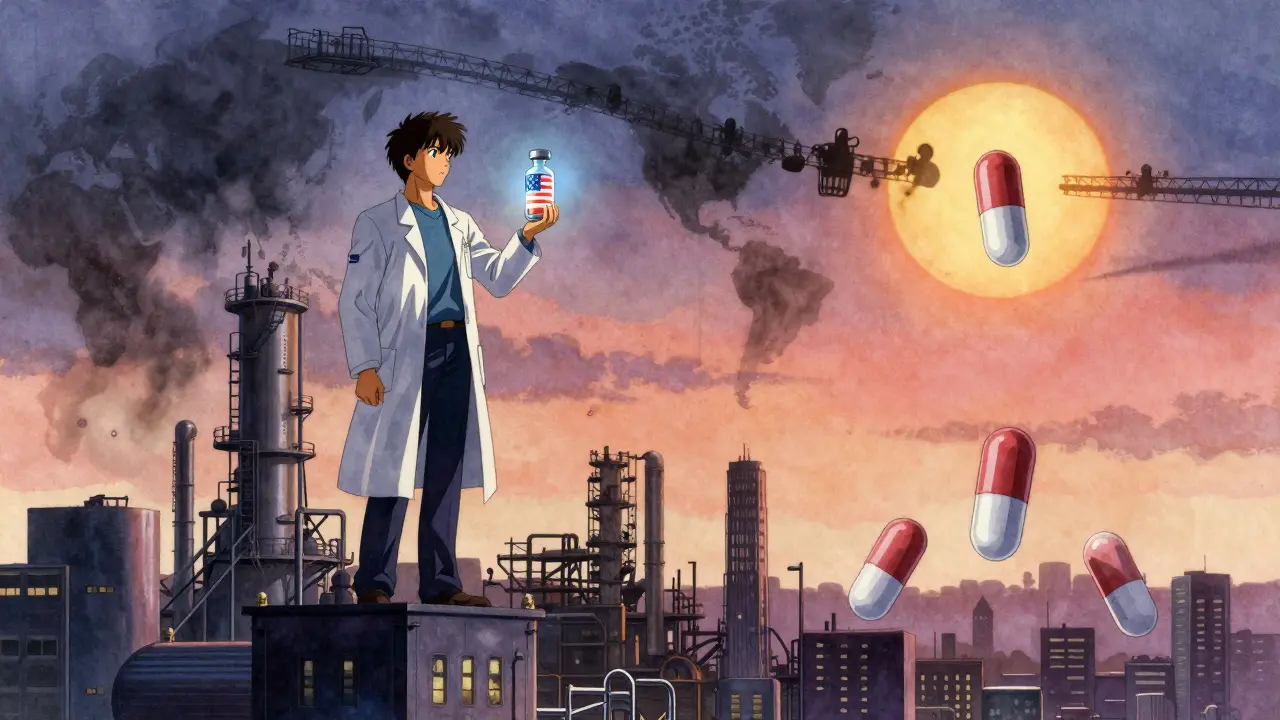
In October 2023, the FDA dropped a major update. The ANDA Prioritization Pilot Program rewards companies that make generic drugs entirely in the U.S. To qualify, your application must prove:- Your bioequivalence studies were done in the U.S.
- Your finished pills or capsules were made in a U.S. facility
- Your active pharmaceutical ingredient (API) came from a U.S. supplier
What’s happening in the industry?
Big players are adapting. Teva, Sandoz, and Hikma have all increased their U.S.-based bioequivalence testing by over 20% since 2022. Contract research firms like PPD and Covance are seeing a 35% jump in U.S. clinical studies. One senior regulatory manager on Reddit put it bluntly: “The domestic manufacturing requirement is noble but unrealistic for complex generics where 92% of specialized excipients still come from Europe and Asia.” But others are betting big. A manufacturing executive shared: “We’ve already shifted two product lines to our Pennsylvania facility. The 2-month review acceleration could mean $120 million in extra revenue for our key cardiovascular drug.” It’s a high-stakes game. The U.S. generic drug market hit $128.7 billion in 2022. Generics make up 88.6% of all prescriptions - but only 15.3% of total drug spending. That’s the power of competition. The faster a generic enters, the faster prices drop.Why do so many applications get rejected?
Getting through the FDA isn’t just about timing. It’s about quality. In 2022, 31.7% of ANDAs got a Complete Response Letter (CRL) - basically, “Your application isn’t ready.” The biggest reason? Chemistry, manufacturing, and controls (CMC) issues. That’s 47.2% of all rejections. Common problems:- Impurities not properly controlled
- Manufacturing processes not consistent
- Stability data incomplete

What about complex generics?
Not all drugs are simple pills. Inhalers, injectables, topical creams, and extended-release tablets are harder to copy. They’re called “complex generics.” They make up 18.3% of pending ANDAs but only 9.7% of approvals. To help, the FDA launched the Complex Generic Drug Product Pilot Program in January 2023. It gives early scientific advice - like a free consultation before you submit. Companies that used it saw fewer surprises and faster approvals.What’s next for FDA generic reviews?
The FDA isn’t slowing down. By late 2024, it plans to roll out AI tools to help review straightforward ANDAs. In testing, AI cut review times by 18.7% for simple applications. Industry analysts predict these changes will shorten the average time to generic approval by 4.3 months by 2026. That could save the U.S. healthcare system $18.7 billion a year. Meanwhile, the U.S. government is pushing harder than ever. Executive Order 14017, signed in 2021, labeled pharmaceuticals a national security issue. The FDA’s new pilot isn’t just about speed - it’s about resilience.What does this mean for patients?
Bottom line: if you’re waiting for a cheaper version of a brand-name drug, the FDA’s review system directly affects when you’ll get it. Priority review means faster access. Domestic manufacturing means more reliable supply. Better applications mean fewer delays. The system isn’t perfect. It’s expensive, complex, and sometimes slow. But it’s working. More generics are getting approved faster than ever. Prices are dropping. And more of the drugs you take are being made closer to home.What’s the difference between priority and standard review for generic drugs?
Priority review takes 8 months from submission, while standard review takes 10 months. Priority review is reserved for first generics, drugs in shortage, or those offering a significant medical advantage. Standard review applies to all other generic applications.
How do I know if my generic drug qualifies for priority review?
Your drug qualifies if it’s the first generic version approved after the brand’s patent expires, it addresses a documented drug shortage, or it offers a clinically meaningful improvement over existing generics. The FDA evaluates this during the initial filing review.
Can I get priority review just by paying more?
No. Priority review isn’t for sale. It’s based solely on the drug’s characteristics - not the applicant’s budget. The FDA uses strict, published criteria. Paying higher fees only covers the cost of review, not faster processing.
What is the ANDA Prioritization Pilot Program?
The ANDA Prioritization Pilot Program, launched in October 2023, gives faster review to generic drugs that use U.S.-manufactured active ingredients, are tested in U.S. clinical studies, and are produced in U.S. facilities. It’s part of a broader effort to reduce reliance on overseas drug manufacturing.
Why do so many generic drug applications get rejected?
Most rejections (47.2%) come from issues with chemistry, manufacturing, and controls - like inconsistent production, uncontrolled impurities, or incomplete stability data. Poorly prepared applications often need multiple review cycles, adding months to the timeline.
How long does it take to get a generic drug approved after a brand’s patent expires?
On average, it takes 2.7 years from patent expiration to first generic approval. Delays come from patent litigation, complex regulatory requirements, and the time needed to prepare a high-quality application. Even with priority review, the process can’t be rushed past the FDA’s scientific standards.


laura Drever
January 14, 2026 AT 02:35Jesse Ibarra
January 14, 2026 AT 08:22lucy cooke
January 16, 2026 AT 03:55Priyanka Kumari
January 17, 2026 AT 12:48vishnu priyanka
January 18, 2026 AT 17:10Kimberly Mitchell
January 19, 2026 AT 05:24Rosalee Vanness
January 20, 2026 AT 23:52Alan Lin
January 21, 2026 AT 11:55Robin Williams
January 22, 2026 AT 15:48mike swinchoski
January 23, 2026 AT 14:24Clay .Haeber
January 24, 2026 AT 07:43James Castner
January 25, 2026 AT 20:47