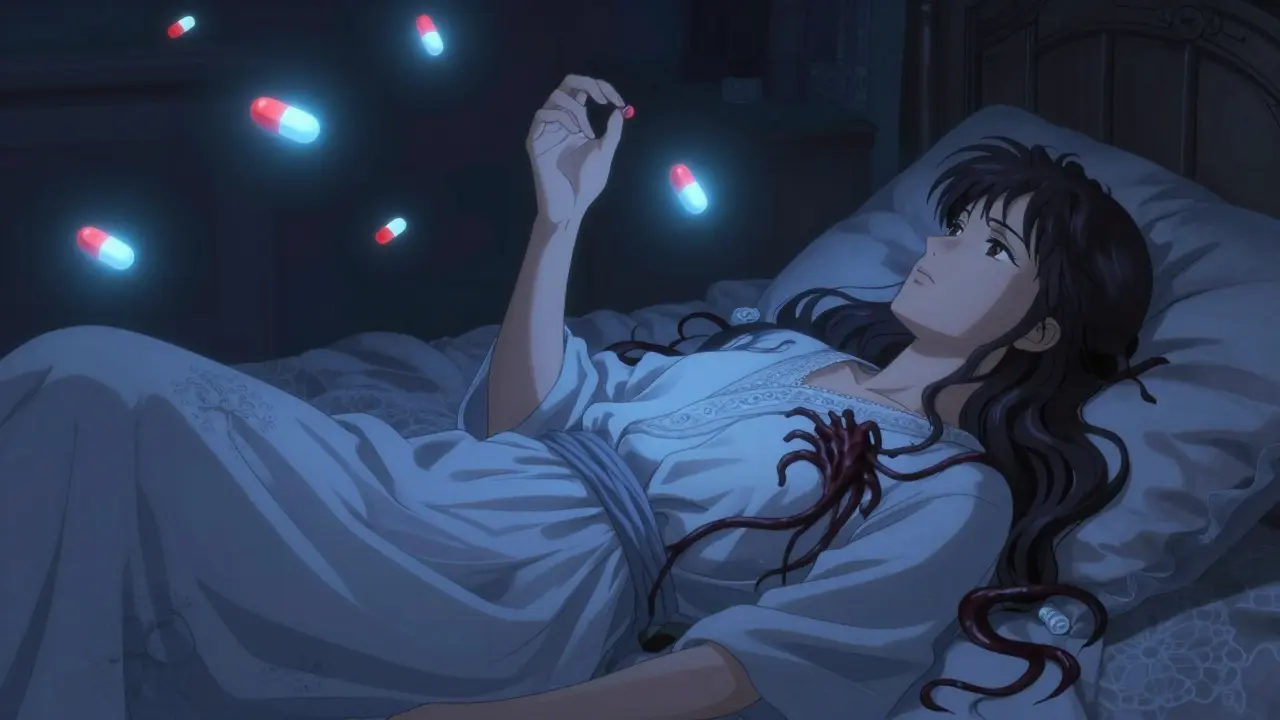
Missing a dose of your prescription medicine might seem harmless-especially if you feel fine. But skipping even one pill can throw off your whole treatment. It’s not just about remembering to take your meds. It’s about keeping the right amount of medicine in your body at all times. When you skip or delay doses, your body doesn’t get the steady level of drug it needs to work properly. That’s when things start to go wrong.
Why Timing Matters More Than You Think
Medicines aren’t like vitamins you take when you remember. They’re designed to work in a very specific rhythm. Your bloodstream needs a consistent amount of the drug to stay in the therapeutic range-high enough to help, but not so high it hurts you. If you miss a dose, that level drops. If you take two doses later to make up for it, it spikes. Both scenarios can be dangerous.
Take antibiotics, for example. You might start feeling better after three days. But the bacteria aren’t gone. Stopping early lets the toughest ones survive. They multiply. Next time, they’re stronger. That’s how antibiotic resistance starts. The CDC says you must finish the full course-even if you feel fine. Same goes for blood pressure pills. You might not feel high blood pressure, but it’s silently damaging your heart and arteries. Skipping doses causes dangerous spikes and crashes in pressure, increasing your risk of stroke or heart attack.
Medicines That Can’t Wait
Some medications are especially sensitive to timing. Warfarin, used to prevent blood clots, is one. Your INR levels must stay in a narrow range. Too low? You could clot. Too high? You could bleed internally. Taking it at the same time every day-usually in the evening-helps doctors predict how your body will react. Miss a dose, and your INR goes off track. You might need urgent blood tests or even hospital care.
Diabetes meds are another big one. If you take insulin or a pill like metformin, timing it with meals is critical. Skip breakfast? Your blood sugar might crash. Take your dose too late? It could spike dangerously. Transplant patients on immunosuppressants like tacrolimus or cyclosporine can’t afford a single missed dose. Their body might start rejecting the new organ. These aren’t hypothetical risks. They’re real, life-threatening outcomes.
What Happens When You Skip
People think, “I’ll just take it tomorrow.” But tomorrow doesn’t fix yesterday. A 2002 study in the Annals of Internal Medicine found that for every extra dose you have to take each day, adherence drops by about 16%. So if you’re on four meds a day, your chance of sticking to the plan is already low. Miss one, and the domino effect begins.
Real consequences? Worsening symptoms. More doctor visits. Emergency room trips. Hospital stays. In the U.S., non-adherence contributes to about 125,000 deaths each year. That’s more than traffic accidents. In New Zealand, where many older adults manage multiple conditions, the issue is just as serious. You might not see it coming. But your body does.

Why People Skip-And How to Fix It
It’s not laziness. Most people don’t skip because they don’t care. They skip because:
- They forget.
- The instructions are confusing.
- They’re scared of side effects.
- The pills cost too much.
- They think they’re fine now, so they don’t need it.
Here’s what actually works:
- Use a pill organizer. A simple weekly tray with morning, afternoon, evening slots makes it impossible to miss. Many pharmacies in Auckland give them out for free.
- Set phone alarms. Label them: “AM Blood Pressure,” “PM Antibiotic.”
- Pair meds with habits. Take your pills right after brushing your teeth or before your morning coffee. That habit sticks.
- Ask your pharmacist. They can simplify your regimen. Maybe you can switch from three pills a day to one combined tablet.
- Use the teach-back method. Before you leave the doctor’s office, say: “So I take this at 8 a.m. with food, and this one at bedtime on an empty stomach?” If you can repeat it correctly, you’ll remember it.
Pharmacists Are Your Secret Weapon
You don’t need to figure this out alone. Pharmacists aren’t just the people who hand out pills. They’re trained to catch timing conflicts, spot drug interactions, and simplify regimens. In New Zealand, pharmacists can review all your meds-even ones from other doctors-and suggest changes. If you’re on five or more medications, ask for a Medication Therapy Review. It’s free under the public health system.
Many pharmacies now offer blister packs with your name and times printed on each dose. No more guessing. No more confusion between similar-looking pills. Just pop one out when the alarm goes off.
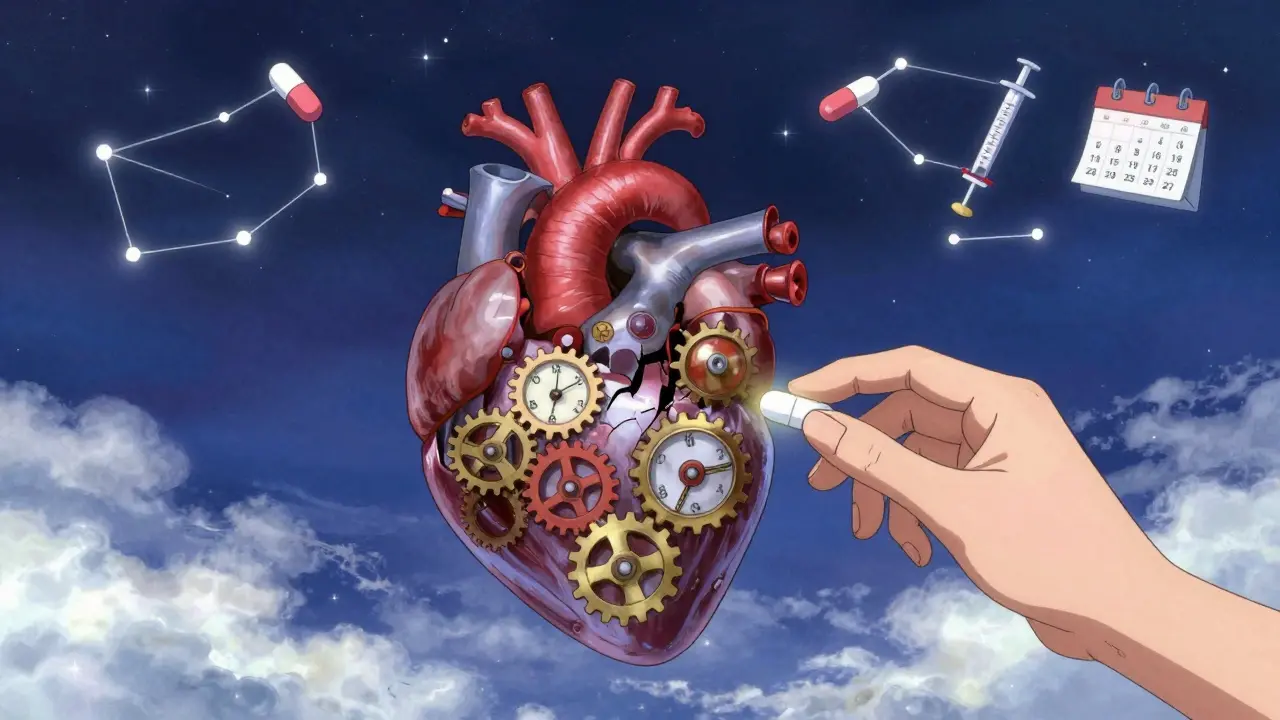
The Bigger Picture
Medication adherence isn’t just about you. It’s about the whole health system. Every missed dose adds up. Hospitalizations from poor adherence cost New Zealand’s health system millions each year. The same is true in the U.S., where the Million Hearts initiative targets 1 million fewer heart attacks and strokes by 2027-mostly by improving how people take their blood pressure and cholesterol meds.
Pharmaceutical companies have to label instructions clearly now. The FDA requires phrases like “take with food,” “take on an empty stomach,” or “take at bedtime.” But labels aren’t enough. You need a system. A routine. A backup plan.
What to Do Right Now
Don’t wait until you feel worse. Start today:
- Look at your prescription labels. Are the times clear? If not, call your pharmacist.
- Set two alarms for each daily dose-one hour before and one after your usual time.
- Get a pillbox. Even a cheap one from the supermarket helps.
- Write down every medication, dose, and time on a sticky note and put it on your fridge.
- Ask your doctor or pharmacist: “What happens if I miss a dose?” Get the answer in writing.
Medication timing isn’t a suggestion. It’s part of the treatment. Your body depends on it. Skipping doses doesn’t just delay recovery-it can undo everything you’ve worked for.
What happens if I miss one dose of my blood pressure medicine?
If you miss a single dose of your blood pressure medication, your blood pressure may rise sharply within hours. This spike can strain your heart and blood vessels, increasing your risk of stroke or heart attack, even if you feel fine. Don’t double up the next dose. Instead, take it as soon as you remember-if it’s within a few hours of your usual time. If it’s close to your next dose, skip the missed one and go back to your regular schedule. Always check with your pharmacist or doctor about your specific medicine.
Can I skip antibiotics if I feel better?
No. Feeling better doesn’t mean the infection is gone. Antibiotics kill bacteria over time. Stopping early lets the strongest bacteria survive and multiply. This leads to antibiotic-resistant infections that are harder-and sometimes impossible-to treat. Always finish the full course, even if your symptoms disappear after a few days.
Why do some pills need to be taken with food and others on an empty stomach?
Food can change how your body absorbs medicine. Some drugs need an empty stomach so they’re absorbed quickly and fully. Others need food to reduce stomach upset or to help the body absorb them properly. For example, taking certain antibiotics without food can cause nausea, while taking cholesterol meds with dinner helps them work better. Always follow the label-it’s based on clinical studies.
I’m on five different medications. Is there a way to simplify this?
Yes. Talk to your pharmacist about a Medication Therapy Review. They can check if any of your meds can be combined, switched to once-daily versions, or removed entirely. Many people find they’re taking duplicates or outdated prescriptions. Simplifying your regimen doesn’t just make it easier-it improves adherence. Each extra daily dose reduces your chance of sticking to your plan by 16%.
I can’t afford my meds. Should I skip doses to make them last longer?
Never skip doses to stretch your supply. That’s dangerous. Instead, talk to your pharmacist or doctor. In New Zealand, you may qualify for a Community Services Card that lowers prescription costs. Some medicines have generic versions that cost far less. Pharmacies often have discount programs or patient assistance options. Skipping doses to save money puts your health at risk-and could cost you more in hospital bills later.



rafeq khlo
March 7, 2026 AT 23:33Medication adherence is not a suggestion-it is a biological imperative. The human body operates on pharmacokinetic rhythms that cannot be manipulated by wishful thinking. Missing a single dose of antihypertensive medication induces a measurable spike in systolic pressure, which in turn increases endothelial shear stress and accelerates atherosclerotic plaque rupture. This is not conjecture. It is quantifiable pathophysiology.
Furthermore, the notion that 'feeling fine' negates the need for compliance is a dangerous fallacy. Hypertension is asymptomatic by design. The damage is occurring silently. The CDC's data on non-adherence-related mortality is not hyperbole-it is a conservative estimate. We are talking about preventable organ failure, stroke, and myocardial infarction. This is not about discipline. It is about survival.
Pharmacists are not mere dispensers. They are clinical gatekeepers. A Medication Therapy Review is not a luxury-it is a standard of care. When polypharmacy exceeds five agents, the risk of adverse drug events increases exponentially. The 16% adherence drop per additional daily dose is not arbitrary-it is derived from longitudinal cohort studies with rigorous statistical controls.
Blister packs, alarms, pill organizers-they are not 'hacks.' They are evidence-based interventions endorsed by the WHO and FDA. To dismiss them as 'band-aids' is to misunderstand the nature of chronic disease management. This is engineering, not optimism.
The cost argument is invalid. In the U.S., 30-day supplies of generic lisinopril cost less than $4 at Walmart. In New Zealand, the Community Services Card reduces out-of-pocket expenses to near zero. If someone cannot afford medication, the failure is systemic-not personal. But the individual still bears the biological consequence. There is no moral exemption from physiology.
Morgan Dodgen
March 9, 2026 AT 06:36So let me get this straight… the government and Big Pharma want us to take pills every single day like obedient robots? 😏
What if I told you the 'therapeutic window' is a myth? That pharmaceutical companies engineered this 'timing' nonsense to keep people hooked? I mean, think about it-how many people are on lifelong meds for conditions they were never diagnosed with in the first place?
My uncle took blood pressure pills for 12 years. He stopped. His BP went normal. He’s alive at 78. Coincidence? I think not. 😈
And don’t even get me started on antibiotics. You think bacteria are 'stronger' now? Nah. They’re just smarter. Evolution is real, bro. They’re not 'surviving'-they’re adapting. And guess who’s forcing them to? YOU. Taking pills when you don’t need ‘em.
Wake up. The system wants you dependent. Not healthy. Dependent. 💊👁️
Philip Mattawashish
March 10, 2026 AT 06:32You people are pathetic. You treat your body like a vending machine. Insert pill. Get results. No effort. No discipline. No respect for the science.
You skip a dose because you're 'too busy'? You think your life is so important that your biology should accommodate your laziness? Your liver doesn't care about your Zoom meeting. Your kidneys don't give a damn about your TikTok scroll.
Antibiotics? You think you're the first person to stop early because 'I feel better'? Millions have died because of this exact mindset. You're not special. You're not smart. You're just a walking infection vector.
And don't even mention cost. If you can't afford your meds, you shouldn't be alive. That's not harsh-it's Darwinian. If you can't afford to stay alive, maybe you shouldn't be here. The planet doesn't need more weak links.
Pharmacist reviews? Pill organizers? Please. You need to stop treating medicine like a chore. It's a covenant with your own survival. You break it, you die. Simple. No excuses. No sympathy.
Tom Sanders
March 11, 2026 AT 19:00Bro. I just forgot to take my pill one day. Didn’t even notice. Felt fine. Next day took it. Life went on.
Like… why is this such a big deal? I’m not dying. I’m not in the hospital. I’m just… living.
Also, I use a pill organizer but I still mix up the colors. I’m not a robot. Chill.
Jazminn Jones
March 13, 2026 AT 08:34The fundamental flaw in public health messaging is the conflation of compliance with moral virtue. This is not about discipline-it is about systems. The fact that we must rely on alarm clocks and pillboxes to ensure adherence speaks to a catastrophic failure in healthcare design.
Patients are not negligent. They are neglected. The system offers no integration: prescriptions are written in silos, pharmacists are underutilized, and education is delivered via pamphlets written in 1998.
The 16% adherence drop per additional daily dose is not a behavioral quirk-it is a systemic indictment. If a patient is on five medications, they are being asked to perform a high-stakes cognitive task with no support infrastructure. This is not patient failure. This is institutional failure.
Furthermore, the emphasis on 'timing' without addressing bioavailability variability across populations is scientifically reckless. Genetic polymorphisms in CYP450 enzymes mean that 'take with food' may be ineffective for 30% of the population. We are not treating patients-we are applying one-size-fits-all protocols to a genetically heterogeneous species.
Until we move from compliance-based models to personalized pharmacotherapy, we will continue to see 125,000 preventable deaths annually. And we will continue to blame the patient.
Stephen Rudd
March 15, 2026 AT 07:09Let me tell you something about New Zealand’s 'free' Medication Therapy Reviews. They’re a joke. I had one last year. The pharmacist spent 12 minutes glancing at my script and said, 'Looks fine.'
Meanwhile, I’m on six meds, three of which are for conditions I never asked for. My GP prescribed them after a 7-minute visit. The system is broken. It’s not about forgetting pills-it’s about being prescribed pills you don’t need.
And don’t get me started on 'blister packs.' I’ve seen them. They’re printed in tiny font. My 72-year-old mum can’t read them. So she just takes them all in the morning. And wonders why she’s dizzy.
Stop telling people to 'set alarms.' Fix the system. Stop overprescribing. Stop making people into pharmacological janitors. This isn’t about willpower. It’s about incompetence.
Erica Santos
March 16, 2026 AT 06:29Oh wow. A 12-page essay on how to take your pills like a good little zombie.
Let me guess-next you’ll tell us to breathe at 12 breaths per minute and blink exactly every 4.2 seconds for optimal health.
You know what’s really dangerous? Believing that pills are magic. That your body can’t regulate itself. That you’re broken unless some chemist in a lab tells you otherwise.
I’ve been off my blood pressure meds for 3 years. I eat clean. I walk. I sleep. My BP is lower than when I was on them. Coincidence? Or maybe… your body knows better than your prescription?
Science? More like superstition with a pharmacy label.
George Vou
March 17, 2026 AT 11:13so like… i took my pill like 2 hours late once and my head felt weird for a sec but then it was fine? so idk why everyone’s acting like it’s a doomsday scenario
also i think the whole 'antibiotics make super bacteria' thing is just fearmongering? like… i’ve had pneumonia twice and i didn’t finish the script both times and i’m still here
maybe we’re just overmedicating? 🤔
Scott Easterling
March 19, 2026 AT 09:40Let me just say this: If you’re taking five different medications, you’re either dying or you’re being exploited. And if you’re relying on a pill organizer, you’re not managing your health-you’re outsourcing it to plastic trays.
And who the hell designed these labels? 'Take with food'? What does that even mean? A banana? A cheeseburger? A protein shake? This isn’t science-it’s a fortune cookie.
Also, the CDC says 125,000 die from non-adherence? That’s a made-up number. Where’s the peer-reviewed source? I’ll bet it’s pulled from a pharmaceutical-funded study. Because if people stopped taking pills, the industry collapses.
And don’t get me started on 'pharmacists as secret weapons.' They’re just glorified cashiers with a white coat. They don’t know your history. They don’t know your diet. They don’t know your stress levels.
You’re being manipulated. Wake up.
Mantooth Lehto
March 20, 2026 AT 06:12I used to be like 'meh, I'll take it tomorrow.' Then I ended up in the ER with a hypertensive crisis. My BP was 210/110. I almost had a stroke.
Now I have three alarms. A pillbox. A sticky note on my mirror. And I cry every time I miss one because I know what happens next.
It’s not about being perfect. It’s about not being a statistic.
❤️
Melba Miller
March 20, 2026 AT 14:15People don’t skip doses because they’re lazy. They skip because they’re terrified. They’ve seen side effects. They’ve seen friends die from 'medication errors.' They’ve been told 'this is life or death' so many times they’ve shut down.
And then someone writes a 2,000-word lecture about 'bioavailability' and 'therapeutic windows' and thinks they’re helping?
What we need isn’t more instructions.
We need trust.
Not fear.
Not guilt.
Not alarms.
Just someone who listens.
And says: 'Let’s fix this together.'
Katy Shamitz
March 20, 2026 AT 20:09My grandma used to take her warfarin at 7 p.m. every night. One day she missed it. Next day she took two. Then she got dizzy. Went to the hospital. Had a bleed. Stayed a week.
She’s 86. She doesn’t remember dates. She doesn’t understand INR. But she remembers: 'I take my little white pill after my tea.'
That’s all she needs.
So if you’re telling someone to 'set alarms' or 'use a pillbox'-you’re missing the point.
What they need is routine. Not technology.
And love.
Not lectures.