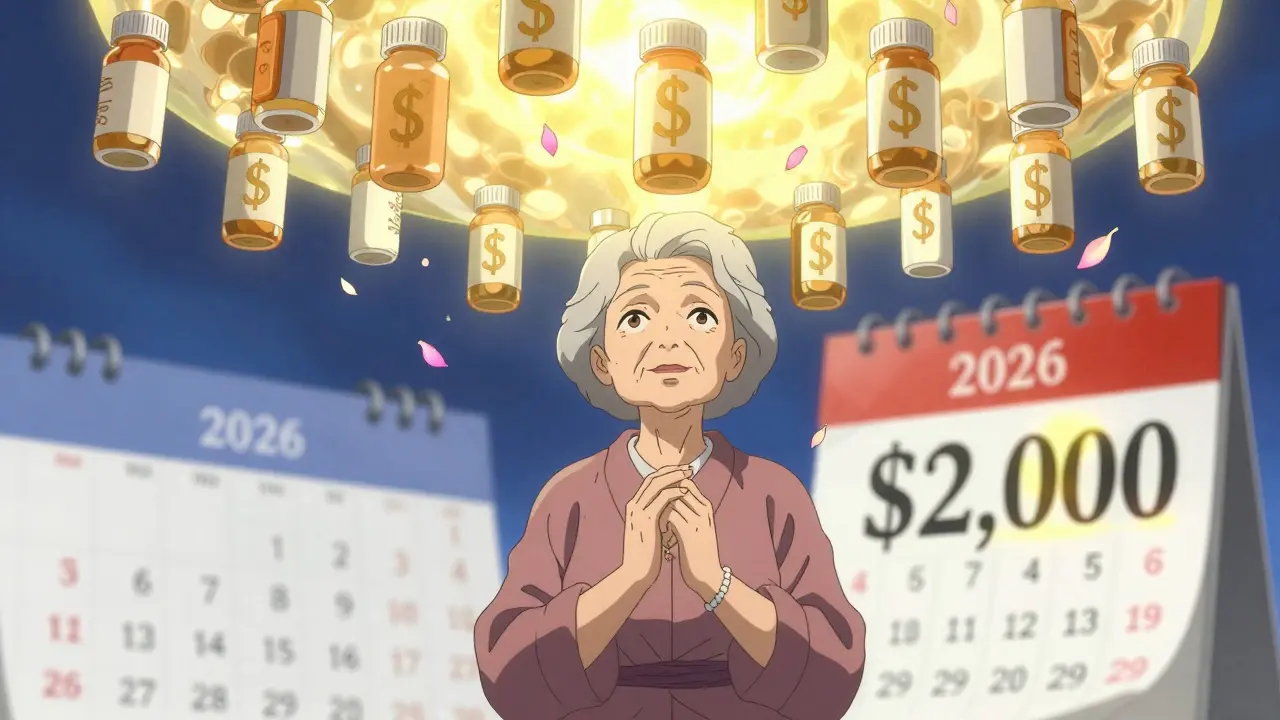
By 2026, if you’re on Medicare and taking generic medications, your out-of-pocket costs for prescriptions have dropped dramatically. What used to cost hundreds or even thousands of dollars a year now often costs nothing after you hit a simple $2,000 cap. This isn’t a rumor-it’s the new reality of Medicare Part D, thanks to changes from the Inflation Reduction Act that fully kicked in by 2025.
What Changed in Medicare Part D for Generics?
Before 2025, Medicare Part D beneficiaries had to pay nearly $8,000 out of pocket before reaching catastrophic coverage. That meant someone taking a few generic meds every month could be stuck paying hundreds of dollars for months on end, even if those drugs cost the pharmacy just a few cents. Now, the maximum you’ll ever pay in a year for all your prescriptions-brand or generic-is $2,000. After that, you pay $0 for the rest of the year.That $2,000 cap includes everything you pay directly: your deductible, your copay, your coinsurance. It does not include your monthly premium. And here’s the key: manufacturer discounts on generics now count toward that cap. That’s huge. In the past, those discounts didn’t help you get to catastrophic coverage faster. Now they do.
How Much Do Generics Cost Now?
Most Medicare Part D plans put generic drugs in the lowest tier. In 2025 and 2026, the median copay for a 30-day supply of a preferred generic is just $10. Some plans charge as little as $5. If you’re enrolled in a Medicare Advantage plan with drug coverage (MA-PD), you’re often paying even less in premiums overall-about $7 a month on average-compared to $39 for a standalone Part D plan.And if you qualify for Extra Help (Low-Income Subsidy), your costs drop even further: $0 deductible, $0 to $4.50 per generic prescription, and no coverage gap at all. About 11 million Medicare beneficiaries got this extra help in 2025, and most of them are on generics.
Why Generics Save So Much
Generics make up 84% of all prescriptions filled under Part D-but only 27% of total drug spending. That’s because they’re cheaper. A generic version of a blood pressure pill might cost $3 at the pharmacy, while the brand name costs $150. Under the old system, you’d pay 25% of $150-$37.50-per prescription. Now, you pay $10 or less for the generic. And once you hit $2,000 in spending, you pay nothing.One user on Reddit, who goes by RetiredPharmacist2023, shared: “My generic blood pressure meds now cost me $0 after hitting the $2,000 cap. Last year, I paid $1,200 more for the same drugs.” That’s not an outlier. The Centers for Medicare & Medicaid Services estimates that in 2025, Part D beneficiaries saved a collective $7.4 billion because of these changes.
Plan Types Matter-PDP vs. MA-PD
There are two main ways to get Part D coverage: standalone Prescription Drug Plans (PDPs) or Medicare Advantage plans that include drug coverage (MA-PDs). Both must follow the same federal rules for copays and caps, but the way they’re structured affects your total cost.MA-PDs bundle your medical and drug coverage into one plan. You pay one monthly premium that covers both. The average drug portion of that premium is only $7. PDPs are separate-you pay your Part B premium, then an extra $39 a month on average for drug coverage. That’s more than five times what MA-PD users pay just for drugs.
So if you’re on mostly generics and don’t need extra benefits like dental or vision, a PDP might still make sense. But if you’re healthy and take a few generics, an MA-PD almost always saves you more overall.
What You Still Need to Watch Out For
The system is simpler now, but it’s not perfect. Some plans still use step therapy-meaning you have to try a cheaper generic first before they’ll cover another, even if your doctor says you need the other one. About 27% of plans have step therapy for at least 15 generic drug classes.Also, some plans still have annual deductibles. Even though the cap is $590, you still have to pay that before your 25% coinsurance kicks in. That’s not a big deal if you only take one or two generics. But if you’re on a lot of meds, it adds up.
And here’s a tricky one: not all generic versions are equal. Your plan might switch you from one generic brand to another that’s just as effective but costs more. That’s called therapeutic interchange. It’s legal, and it can raise your copay. You need to check your plan’s formulary every year during Open Enrollment.
How to Find the Best Plan for Your Generics
The Medicare Plan Finder tool is your best friend. It’s updated every October for the next year’s plans. Type in your exact medications-don’t just say “blood pressure meds.” Put in the brand name and the generic name. The tool will show you which plans cover them, what tier they’re on, and what your copay will be.But here’s the catch: 32% of people who use the tool say they need help figuring it out. If you’re unsure, call Medicare at 1-800-MEDICARE. Or ask your pharmacist-they see these formularies every day. Don’t just pick the cheapest premium. Pick the plan that gives you the lowest total cost for the drugs you actually take.
Who Benefits the Most?
If you take three or more generic medications every month, you’re likely to hit the $2,000 cap by late summer or early fall. After that, your drugs are free. That’s a game-changer for people with chronic conditions: diabetes, high blood pressure, high cholesterol, thyroid issues, arthritis.One study found that beneficiaries taking five or more generics saved an average of $400 a year just from the new cap. For someone on insulin and three other generics, that could mean $1,200 in savings.
People on Extra Help save even more. Their copays are capped at $4.50 per generic, and they never hit a gap. About 36% of all Part D enrollees are now in this group, thanks to expanded eligibility rules in 2024.
What’s Next?
In 2026, a new program called the Selected Drug Subsidy Program will start. It gives plans a 10% subsidy if they lower costs for certain high-cost generics. That could mean even lower copays for meds like generic insulin or complex heart medications.Biosimilars-generic versions of biologic drugs-are also starting to show up in Part D formularies. These aren’t traditional generics, but they work the same way: lower cost, same effect. By 2028, they could cover 35% of the biologic market, bringing even more savings.
Still, experts warn: if drug prices keep rising faster than inflation, the system could get strained. The government’s reinsurance payments to plans are shrinking, meaning private insurers are taking on more risk. That could lead to more restrictions on certain generics down the road.
Final Checklist: Are You Getting the Most Out of Your Generics?
- Do you know your exact generic drug names and dosages?
- Have you checked your plan’s formulary on the Medicare Plan Finder this year?
- Are you paying a standalone Part D premium? Could you switch to an MA-PD to save more?
- Do you qualify for Extra Help? Apply at SSA.gov-it’s free and can cut your costs in half.
- Have you asked your pharmacist if your generic was switched? If your copay went up, find out why.
- Did you track your out-of-pocket spending? Once you hit $2,000, your drugs should be free for the rest of the year.
Medicare Part D was never designed to be simple. But in 2026, if you’re taking generics, it’s the most affordable it’s ever been. The system still has gaps, but the savings are real. You just need to know how to use it.




Tiffany Adjei - Opong
January 6, 2026 AT 01:37Okay but let’s be real - the $2,000 cap only matters if you actually hit it. Most people on 1-2 generics never come close. I’ve seen folks pay $5 a month for 5 years and then act like they won the lottery. The system’s still rigged for the high-utilizers, and the rest of us? We just get pamphlets.
Mukesh Pareek
January 7, 2026 AT 21:30While the marginal cost reduction for Tier 1 generics is statistically significant under the IRA’s reinsurance framework, the structural inefficiencies in formulary tiering and therapeutic interchange protocols remain unaddressed. The $2,000 out-of-pocket cap is a nominal improvement, yet the lack of price transparency and PBMs’ opaque rebate systems continue to distort true cost dynamics.
Ashley S
January 9, 2026 AT 04:45So now we’re supposed to be grateful because we’re not going broke? This is basic healthcare, not a charity raffle. They took away our pain and called it progress. I’m not impressed.
Jeane Hendrix
January 9, 2026 AT 13:21Wait - so the manufacturer discounts now count toward the cap? That’s huge!! I didn’t realize that. I’ve been tracking my spending but forgot to add those in. So if my Eliquis generic discount is $40 per script and I get 12 scripts a year, that’s $480 toward my cap? That’s like getting a free month of meds?? I’m gonna check my 2025 statements again… 😅
Tom Swinton
January 9, 2026 AT 18:03Guys, I just want to say - this is the most life-changing thing to happen to Medicare in my lifetime. I’m 72, on insulin, metformin, lisinopril, and atorvastatin - used to pay $1,100 a year just for those four. Last year? I hit the cap in August. Since then? ZERO. I’ve been crying every time I walk up to the counter. My pharmacist asked if I was okay. I said, ‘No, I’m just overwhelmed with gratitude.’ This isn’t policy - this is dignity. Thank you, Congress - even if you didn’t mean to do it.
Katelyn Slack
January 11, 2026 AT 01:32just a heads up - make sure your pharmacy is scanning your card right. my mom got charged full price for a generic because the system didn’t register her cap was hit. called medicae, fixed it in 10 mins. check your statements!
Melanie Clark
January 11, 2026 AT 08:49This is all a distraction from the real problem - the government is using your meds as leverage to control the elderly. The cap? It’s a trap. Next year they’ll say ‘you’re not spending enough so we’re raising premiums’ or ‘you’re hitting the cap too fast so we’re removing generics from formulary.’ Mark my words - this is the first step to rationing. They want you dependent. And they’re winning.
Stuart Shield
January 11, 2026 AT 15:07It’s like the government finally said ‘hey, we’re not monsters’ - and for once, it stuck. I used to see my dad skip doses just to make the pills last. Now he laughs and says, ‘I’m not choosing between my heart and my groceries anymore.’ That’s not policy. That’s humanity.
Lily Lilyy
January 11, 2026 AT 18:01Everyone deserves to breathe easy when they take their medicine. 💖 If you’re on generics, you’re not just saving money - you’re saving your peace. Keep checking your formulary, keep asking questions, and never stop fighting for your health. You’ve got this, beautiful souls. 🌸
Susan Arlene
January 11, 2026 AT 18:10so like… i dont even know what a formulary is but my pills are cheaper now and that’s all i care about
Joann Absi
January 12, 2026 AT 10:49AMERICA IS WINNING 🇺🇸🔥 This is what happens when we stop letting big pharma run the show! The system finally works for the PEOPLE not the CEOs! 🙌💉 #MedicareWins #GenericsForLife
Venkataramanan Viswanathan
January 14, 2026 AT 09:21While the policy is commendable, the implementation remains inconsistent across states and pharmacy networks. In India, we have a similar generic-driven system, but with centralized pricing and no formulary switching. The U.S. model, despite its improvements, still suffers from fragmentation. A unified national formulary would be ideal.
Vinayak Naik
January 15, 2026 AT 05:40My cousin in Ohio just switched from a PDP to an MA-PD and now pays $4/month for ALL her meds - including a $1200 insulin. She didn’t even know she could do it. Tell your grandma. Tell your uncle. This ain’t rocket science - it’s just knowing where to look. 🙏